Navy Yard Worker Turned Brooklyn’s Most Powerful Politician
by Eric Patrick Cameron, Glucksman Ireland House, New York University
© Eric Patrick Cameron, 2024. All rights reserved.
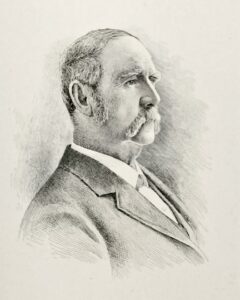
Portrait of Hugh McLaughlin, Brooklyn politician. The National Cyclopaedia of American Biography Supplement I. New York: James T. White & Company. 1910. https://archive.org/details/nationalcyclopae00newy (Enhanced and Color-Corrected by Eric Patrick Cameron)
Born April 9, 1826 on Furman Street in Brooklyn, lifelong Brooklynite Hugh McLaughlin was the “boss” of Brooklyn’s Democrats throughout the 1860s and led the party until Patrick McCarren took over in 1903. The youngest of ten children, McLaughlin got his start in the workforce thanks to his older brother. The two managed a fish market together. When his brother died, he became the sole proprietor of the business. Seeking more from life, McLaughlin joined the volunteer fire forces of New York and Brooklyn, fully aware of their political potency. His political leadership was strengthened in 1855 when he was appointed as the Navy Yard’s master foreman of civilian labor.[1]
“Go and see Hughey” became a familiar phrase heard by aspiring workers whenever someone sought out opportunities in the Navy Yard. Everyone seemed to like McLaughlin, as his youth and personal popularity were a great advantage to him.
Right after his time at the Navy Yard, McLaughlin’s political power grew. He won the nomination for Register in 1860. Shortly after being elected, the Front Street managers were driven out of power. He was re-elected in 1864 and re-elected again, for the last time, in 1870. After his position as the Register, he remained one of Brooklyn’s most powerful political figures until his death.[2]
For fifty years, he led the Democratic party “to victory or reformed them after defeat.” When remembering McLaughlin after his passing on December 8, 1904, chairman of the committee Colonel Bell remarked: “For fifty years Mr. McLaughlin was a force in Brooklyn life and for nearly the whole of that period a controlling force in its political life. He started on his career without the advantages of social position, wealth, or scholastic training. Nature had endowed him, however, with an excellent physique, a memory of extraordinary power and the gift of absorbing from those he came in contact with the knowledge or information which they had painfully acquired by direct contact with either books or men. By means of these natural gifts, strengthened by experience, he was enabled to accomplish great things and what would have been regarded as impossibilities, if it had been predicted of him at the outset of his career.” He concludes his statement by saying, “the death of Mr. McLaughlin removes a great historic character from Brooklyn, and it is well at this time that the General Committee should pause and look back over the past half century of his activities and lay upon the bier of the dead leader its tribute.” Senator McCarren, McLaughlin’s successor, stated that McLaughlin’s “death provokes comment all across the United States. His career and political life were known to the people in almost every part of the country; that is surely a distinction that rarely comes to a man in American politics.”[3]
At the time of his death, McLaughlin was survived by his wife of forty-five years, Helen Keyes, and two daughters. McLaughlin and Keyes had a son, Hugh Harvey (known as simply “Harvey”), who passed away from a two-week-long illness on June 7, 1878 at age sixteen. This was especially devastating for Hugh as he and his son were particularly close.[4] They also had another daughter who passed away as a child.[2]
[1] Brooklyn Is America. Ralph Foster Weld. Pg 124. 1950. Columbia University Press, New York.
[2] Brooklyn Eagle. Thursday December 8, 1904. Newspaper. Brooklyn, New York. Newspapers.com.
[3] Brooklyn Eagle. Saturday December 10, 1904. Newspaper. Brooklyn, New York. Newspapers.com.
[4] Brooklyn Eagle. Friday June 7, 1878. Newspaper. Brooklyn, New York. Newspapers.com.