By Gracelyn Barmore-Pooley, Glucksman Ireland House, New York University
© Gracelyn Barmore-Pooley, 2024. All rights reserved.
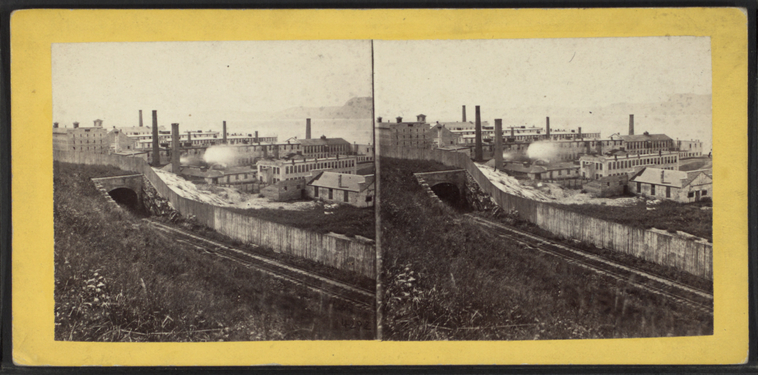
Sing Sing Correctional Facility, including workshops where prisoners may have made clothing, 1865. From the New York Public Library Digital Collections, Dig ID: G91F152_004F.
Irishtown was not immune to crime or criminal activity, and some of its residents ended up running into trouble with the law. For instance, in 1852, a Patrick McGowan was examined and committed to trial for bigamy charges.[1] He had abandoned his previous wife and moved to Green Lane, an alley in Irishtown, where he became “smitten with the charms” of a widowed Mrs. Duffy and married her.
Some residents who ended up incarcerated were transferred from Kings County to Sing Sing Prison in Ossining, New York. It was built on the grounds of a quarry in 1828, the third prison in New York State.[2] Both male and female inmates quarryed stones, produced boots, hats, shoes, mattresses, and barrels, as part of their punishment regiment.[3]
There were eighty-five natives of Ireland admitted to Sing Sing in 1870, arrested for crimes of theft, like larceny, burglary, robbery, and embezzlement.[4] Nearly all were Catholic.[5] They joined Edward Sullivan, who lived at 302 Front Street in Irishtown with his father at the time of his arrest, who had been convicted of burglary of the third degree and sentenced for four years and six months on March 2, 1869.[6] Sullivan’s admission record reveals that he was born in Ireland but emigrated to the United States when he was around three years old. He was only nineteen years old at the time of his arrest. Sullivan was 5’9 ¾”, weighed 138 pounds, had brown hair, and a complexion described as “florid.” He had lost two of his upper front teeth and had scars on his chin and under his left jaw. Sullivan was literate, a moderate drinker, a Catholic, and worked as a boatman – a description consistent with the rough-and-tumble working class neighborhood in the shadow of the Brooklyn Navy Yard. He confessed to the burglary.
The Sullivan family can be found in the 1860 Federal Census. Edward’s father, after whom he was named, worked as a ship carpenter in New York’s Seventh Ward near the East River.[7] He and his wife Bridget had eight children; all but the youngest two were born in Ireland. Fifteen ships were constructed in the Brooklyn Navy Yard in the 1860s which may explain the family’s relocation to Irishtown.[8]
In December 1868, an article in the Brooklyn Union described Sing Sing as “one of the easiest places to escape from that can be imagined,” noting that sixteen prisoners had escaped so far that year.[9] Indeed, just days after Edward Sullivan was admitted to Sing Sing, there was a “shocking” and “terrible” revolt.[10] Two prison guards were gagged, and one was killed, while five convicts escaped but were later caught by authorities.[11] All of the convicts involved in the revolt had been arrested for crimes of burglary or robbery; one was John Mulvey who, like Edward Sullivan, was sent directly from Brooklyn instead of New York like the rest.[12]
Mulvey was born in Ireland, and was twenty-one years old in 1868, the year of his arrest and his involvement in the riot.[13] He was convicted of first-degree burglary, sentenced to two years six months, and was admitted on February 10, 1868. Mulvey and his parents lived in Brooklyn but outside of Irishtown, at 23 Carroll Street. His complexion was “dark and ruddy,” and he stood at five feet eight inches. Convicted for a similar offense to Sullivan, his involvement in both crime and the ensuing revolt demonstrate the violence common to working-class Irish life.
Sullivan certainly would have heard the commotion of the revolt, if he did not witness it directly, and he likely experienced the effects of any resulting crackdowns or punishment of prisoners. He was still serving his sentence the following year, when the 1870 Federal Census enumerated the inhabitants of Sing Sing Prison.[14] What became of him thereafter remains a mystery.
[1] “Brooklyn City News Gatherings,” New York Daily Times (New York), April 2, 1852, p. 3. ProQuest Historical Newspapers.
[2] Guy Cheli, Sing Sing Prison, Images of America (Arcadia, 2003), p. 9.
[3] Ibid, p. 15.
[4] Profile of Irish Prisoners, Resurrecting the Ethnic Village, accessed 10 December 2024, https://ethnic-village.org/irish-prisoners-1870/
[5] Ibid.
[6] Edward Sullivan, Ancestry.com. New York, U.S., Sing Sing Prison Admission Registers, 1865-1939 [database on-line]. Provo, UT, USA: Ancestry.com Operations, Inc., 2014.
[7] Edward Sullivan, Dwelling 311, New York Ward 7 District 5, p. 153. Ancestry.com. 1860 United States Federal Census [database on-line]. Lehi, UT, USA: Ancestry.com Operations, Inc., 2009.
[8] Illustrated guide to the Brooklyn Navy Yard prepared by the Brooklyn Daily Eagle Information Bureau. Brooklyn, New York Eagle Book and Job Printing Department1901. Readex: American Pamphlets, Series 1, 1820-1922: From the New-York Historical Society. https://infoweb-newsbank-com.proxy.library.nyu.edu/apps/readex/doc?p=AMPAM1&docref=image/v2%3A145728D353737E00%40EAIX-1476BC566921D0D0%40-15A7A17EB2743AB0%4031
[9] “Sing Sing Prison: The Manner in Which the Prisoners Are Treated,” The Brooklyn Union (Brooklyn, New York), December 4, 1868, p. 4. Brooklyn Newspapers.
[10] “Shocking Revolt at Sing Sing,” The Brooklyn Union (Brooklyn, New York), March 19, 1869 p. 4. Brooklyn Newspapers.
[11] “The Revolt at Sing Sing,” New York Times (New York), March 20, 1896, p. 7. Proquest Historical Newspapers.
[12] “Shocking Revolt at Sing Sing,” The Brooklyn Union (Brooklyn, New York), March 19, 1869 p. 4. Brooklyn Newspapers.
[13] John Mulvey, Ancestry.com. New York, U.S., Sing Sing Prison Admission Registers, 1865-1939 [database on-line]. Provo, UT, USA: Ancestry.com Operations, Inc., 2014.
[14] Edward Sullivan, Sing Sing, Westchester, New York, p. 193. Ancestry.com. 1870 United States Federal Census [database on-line]. Lehi, UT, USA: Ancestry.com Operations, Inc., 2009.