by Marion R. Casey, Glucksman Ireland House, New York University.
© Marion R. Casey, 2024. All rights reserved.
When Patrick Shanahan opened an account with Emigrant Savings Bank in 1855, the bank’s accountant recorded his birthplace as “Athlacky” in Co. Limerick. This is actually the parish of Athlacca, which contains ten townlands.[1] Shanahans lived in three of these in 1851: Rathcannon, Rosstemple, and Tullerboy.[2]
Patrick Shanahan, a bookbinder living at 102 Bridge Street in Brooklyn’s Irishtown, was from Rathcannon because his mother, Margaret Mulcahy Shanahan – whom he reported was alive in Ireland in 1855[3] – is documented there in Griffith’s Valuation in 1851. This tax evaluation revealed that she was renting a “house and forge” from the Rev. Carew Smith Grady for ten shillings a year. “Forge” suggests that Patrick’s deceased father, Michael, may have been the local blacksmith. The Shanahans were subtenants because Grady himself paid rent to the Venerable Archdeacon W. Wray Maunsell.[4]
When Patrick was growing up, the land around Rathcannon was “exceedingly productive.” Samuel Lewis noted that most of the area was either under tillage, or was meadow and pasture for cattle grazing, and that “there is not an acre of waste land”. Lewis also remarked on the treeless landscape, “except around the houses of the principal inhabitants.” The nearest inhabited big house, Castle Ivers, was a mile from Rathcannon.[5] It was built in the early nineteenth century and was the residence of Robert Ivers, who was also leasing from Maunsell, the Archdeacon of Limerick.[6]
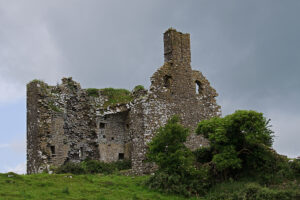
The ruins of Rathcannon Castle in Athlacca, Co. Limerick. Credit: Castles of Munster: Rathcannon, Limerick (1) by Mike Searle, 2022.

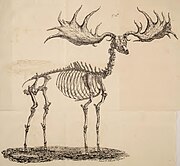
Illustration of the Rathcannon Elk from John Hart, A Description of the Skeleton of the Fossil Deer of Ireland, Cervus megaceros (1825).

Young Patrick Shanahan would have been more familiar with the ruins of Rathcannon Castle, which is demarcated on the Ordnance Survey map of the townland.[7] It was described by Lewis as “a very ancient fortress” of the O’Casey family that was built “on the summit of a fertile eminence” in the 16th century.[8] It was near this castle that Maunsell, in 1824, discovered the complete skeleton of Megaloceros giganteus, a giant Irish deer with 12 foot antlers. Known as the Rathcannon Elk, Maunsell sent it to the Royal Dublin Society and today it is on display in Ireland’s Natural History Museum.[9]
The nearest village to Rathcannon was Athlacca, which is why Patrick Shanahan named it in the Emigrant Test Books. A new Catholic Church was built there in 1840; it was dedicated to St. John the Baptist, most likely because the local holy well (marked on the Ordnance Survey Map), was also associated with this saint.[10] Lewis noted that there was a school for Catholic children in Athlacca in 1837; Patrick Shanahan may have been among the 60 boys being educated there.[11]
In 1841 the population of Athlacca was 1,372.[12] Ten years later, emigration and deaths accelerated by the Famine had caused a 6% decrease in the parish. The greatest change was in the population who inhabited the worst housing, in other words, the poorest. In 1841 there were 125 families living in 4th class housing compared with only 47 in 1851. The number of families living in 2nd and 3rd class housing in the parish of Athlacca, which includes Rathcannon, actually doubled during the Famine. Likewise, the percentages of those employed in both agriculture and manufacturing in the area remained stable between 1841 and 1851.[13] Indeed, an 1849 description of the area observed wheat, oats, barley and turnip crops as well as dairy farming, including butter production in this central part of Co. Limerick.[14] This suggests that Patrick Shanahan’s decision to emigrate in 1841 on the Henry Clay was not motivated by crisis conditions.
Patrick Shanahan also told Emigrant’s accountant that he had a brother, Michael, who was in Ireland in 1855. The 1901 Census records 60-year-old Michael Shanahan, an agricultural labourer, and his 65-year-old Cork-born wife, Mary, as residing in Rathcannon.[15] If they are indeed brothers, Michael would have only been an infant when Patrick left for America. Their house, presumably the same one Margaret Mulcahy Shanahan lived in, was classified as 3rd class by the census taker: it was a two-room cottage with two windows.[16] While the Shanahan name seems to have died out by 1911, there was still a Mulcahy family in Rathcannon, possibly unaware of a distant cousin who had emigrated to Brooklyn’s Irishtown a half a century earlier.[17]
[1] https://www.townlands.ie/limerick/athlacca2/
[2] https://www.askaboutireland.ie/griffith-valuation
[3] EISB Acct. No. 8623
[4] https://www.askaboutireland.ie/griffith-valuation
https://griffiths.askaboutireland.ie/gv4/z/zoomifyDynamicViewer.php?file=172020&path=./pix/172/&rs=8&showpage=1&mysession=2940429611238&width=&height=
[5] https://www.libraryireland.com/topog/A/Athlacca-Coshma-Limerick.php
[6] https://landedestates.ie/estate/2404
[7] https://dri.ie/os200/spotlight/os200/catalog/19138f21d051123f41983605f5fdc27a
[8] https://www.libraryireland.com/topog/A/Athlacca-Coshma-Limerick.php
[9] https://www.libraryireland.com/topog/A/Athlacca-Coshma-Limerick.php; https://www.paleophilatelie.eu/description/stamps/ireland_2007.html
[10] https://www.buildingsofireland.ie/buildings-search/building/21903904/catholic-church-of-saint-john-the-baptist-athlacca-limerick; https://dri.ie/os200/spotlight/os200/catalog/19138f21d051123f41983605f5fdc27a
[11] https://www.libraryireland.com/topog/A/Athlacca-Coshma-Limerick.php
[12] https://ucc.maps.arcgis.com/apps/MapSeries/index.html?appid=83617870f2624735b4f5cae21077ea36
[13] https://ucc.maps.arcgis.com/apps/MapSeries/index.html?appid=83617870f2624735b4f5cae21077ea36
[14] https://www.limerick.ie/sites/default/files/atoms/files/after_the_famine_-_the_economy_of_limerick_county_and_city_in_the_1850s.pdf
[15] https://www.census.nationalarchives.ie/pages/1901/Limerick/Athlacca/Rathcannon/1489353/
[16] https://www.census.nationalarchives.ie/reels/nai000982092/
[17] https://www.census.nationalarchives.ie/pages/1911/Limerick/Athlacca/Rathcannon/618001/