by Maeve Carey-Kozlark, Glucksman Ireland House, New York University
© Maeve Carey-Kozlark 2024. All rights reserved.
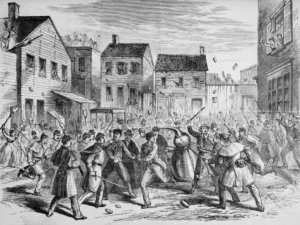
A drawing from Frank Leslie’s Illustrated Newspaper depicting soldiers raiding an illegal distillery in Brooklyn’s Irishtown in 1869, via Frank Leslie’s Illustrated Newspaper, December 25, 1869, p. 253.
In the 1850s, New York City was a diverse melting pot of immigrants who (in the case of the Irish and Germans in particular) brought distinct and long-standing drinking cultures with them. Around this same time, the Temperance Movement, which aimed to reduce alcohol consumption which reformers associated with crime, poverty, and moral decay, had been gaining traction since the early 19th century and was now in full swing. Liquor laws and legislation in the city were often employed as tools of social control to target these immigrant communities amid concerns over public order, morality, and cultural assimilation (or lack thereof). This ultimately led to the passage of the Maine Law in 1851, effectively prohibiting the sale of alcohol in Maine, with several other states following suit shortly thereafter. On April 9th 1855 New York State made its own short-lived attempt at enforcing prohibition through the Act for the Prevention of Intemperance, Pauperism, and Crime.[1] The Act was met with widespread opposition, difficulties surrounding enforcement, and challenges in court, and was ultimately struck down by the Supreme Court later that same year.[2]
For Irish immigrants, pubs and taverns were vital social hubs where people gathered for camaraderie, community news, and support networks. Efforts to control alcohol consumption through targeted legislation frequently escalated into direct confrontations with immigrant communities, particularly as drinking establishments often served a dual purpose as key political hubs. The Tammany Hall machine, which came to dominate New York politics, relied heavily on Irish support and cultivated close relationships with saloon and tavern owners to further facilitate this, and in turn allowed some saloon and tavern owners to bypass or ignore certain restrictions. In this way, alcohol consumption and tavern culture became linked to immigrant political empowerment, as these spaces fostered a sense of solidarity and community leadership.[3]
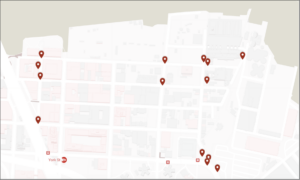
Registered liquor dealers in and around Brooklyn’s 5th Ward in 1853, mapped
Individual liquor dealers wishing to remain above-board faced high taxes and licensing fees. The 1853 Hearne Directory for Brooklyn lists seventeen registered liquor dealers in and around the Fifth Ward, the majority of which were Irish-owned and operated and concentrated near the Navy Yard or other industrial centers:[4]
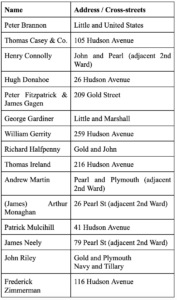
This number does not reflect pub or saloon operators, nor the high number of grocers and hotel and boarding house operators in the area who were also likely to have held liquor licenses during this time. The fees for above-board liquor licenses depended on the scale of the business and were designed to make operations prohibitive for small or unregistered sellers; costs remained manageable low for established taverns, but high for any new entrants, making it difficult for small or more informal vendors to enter the market legally. Licenses also often came with restrictions on hours of operation and age limits, especially as the temperance movement gained traction.
The Bureau of Internal Revenue, established in 1862 amid the financial pressures of the Civil War, later began to enforce taxes on not just the sale and distribution but also the production of alcohol, requiring distillers to register and pay federal taxes on every individual barrel or, in some cases, gallon produced. These federal taxes varied based on the type and potency of the alcohol in question, and were substantial enough that they incentivized illegal production and bootlegging, especially among emigrant communities who often could not afford to pay these additional fees. Thus, even before Prohibition’s later restrictions and despite the already high concentration of makers and dealers in the neighborhood, Brooklyn’s Irishtown quickly gained a reputation for its thriving, clandestine distillery operations producing poitín—a potent, unregulated form of Irish moonshine. This informal, untaxed economy generated substantial revenue for the area’s residents, especially in working-class neighborhoods struggling with low wages. The poitín trade in Irishtown was dominated by a tight-knit group of Irish-born locals: John Devlin, John Whiteford, James “Ginger” Farrell, and Ned Brady, although a number of others were active participants or accessories to the operations as well. Distilleries were concealed in basements and backrooms of residential and industrial buildings, forming an underground network of easily-disassemblable production sites. Several popped up on the outskirts of the neighborhood that abutted the Navy Yard––particularly Little and United States Streets (at which there stood just one formally registered liquor dealer, Peter Brannon). These operations, if registered at all, tended to list themselves as “boathouses” but in actuality were producing and providing easier and comparatively cheaper access to liquor to the Navy Yard’s considerable roster of employees and crews on the vessels that passed through on a daily basis.[5]
This underground economy is reflected in Emigrant Savings Bank Records: while many of the operators of illegal distilleries did not hold accounts, one––Co. Tyrone-born John Devlin, “the head and front of the ring”––held four separate accounts (nos. 13841, 17217, 23400, and 25781) between the years 1857-1861, with his highest balance at any one time totaling $1,387.02 in 1860 (roughly equivalent to $53,000 in 2024).[6] This balance is incongruent with his background––born to poor tenant farmers in Fallagh, Bodoney Lower Civil Parish, Tyrone––stated occupation at that time (a laborer, per census records), and the statuses of his joint-account-holders: his brother, John, also a laborer, and his wife Bridget, a housekeeper unable to read or write. This number in fact exceeds the maximum balances of above-board liquor dealers for whom Emigrant Savings Bank account and deposit data is available for: William Gerraty (acct. 2868) with $828.69 ($31,900 today) and J. Arthur Monaghan (acct. 15206) with $511.41 ($19,700 today). A witness in Devlin’s later trial suggests that he may have opened bank accounts under the false name Francis Devlin as well; indeed, there is one account matching this name (no. 3084) that lists his same birthplace of Fallagh, Tyrone, although deposit information is unavailable.[7]
Devlin was arrested the evening of November 17, 1866 and subsequently released after posting a $50,000 bail bond (equivalent to nearly $1 million today), indicating his operation continued to expand and become increasingly lucrative in the years following the last activity in his deposit accounts. Federal officials seized his safe at the time of this arrest. Prior to these charges, Devlin was arrested at least four times prior: twice in September 1850 for petit larceny, once in November 1853 for “similar charges,”, and again in July 1854 for further “similar charges,” after which he was imprisoned for an unknown period of time.[8] Per an 1866 Brooklyn Eagle article, the operation of illegal whiskey distilleries was not John’s first foray into defrauding the government: he was convicted at a “later period,” sometime between 1853 and the opening of his first Emigrant Savings Bank account in 1857, for “swindling the government by producing false certificates of soldiers’ bounties” whilst working in bounty brokerage services, for which he was fined (and paid) the sum of ten thousand dollars.
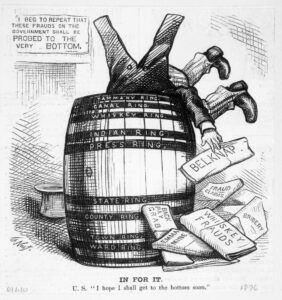
U.S. Secretary of War, William W. Belknap, dives into the Barrel of corruption. (He was impeached for malfeasance in office). Nast cartoon, 1876
Also arrested on November 17, 1866 was a suspected accomplice of Devlin’s, T.B. Tilton, who posted and was released on a $25,000 bail bond (or roughly $500,000 today). As Inspector of Distilleries in the Third Collection District, Tilton was accused of accepting “a handsome sum” from Devlin per barrel for inspecting his whiskey and placing “government brands” on them, which allowed for their sale and distribution by dealers, saloons, and other licensed, above-board gathering places.
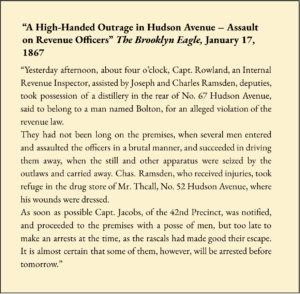
Devlin was tried before Judge Charles Benedict in the U.S. Circuit Court in 1868 and was ultimately indicted for selling over 300,000 gallons of whiskey without a license. His defense argued that they (did) “not propose to show that he was not a wholesale liquor dealer, nor that he held a license;” that John “knew the law” and “no man evaded it with greater profit,” but that government officers “neglected their duties” and to “enforce the law,” citing collusion and an ignored attempt by Devlin to register for a license in the months following his arrest in January 1867.[9] Another distillery in the rear of 67 Hudson Avenue in Irishtown was violently seized just two weeks prior to Devlin’s arrest, with a Brooklyn Eagle article describing the chaos that ensued:
Period newspapers and sheet music from the time depict a vibrant culture surrounding poitín in Irishtown, and this reputation lasted well into the turn 20th century; an 1896 Tin Pan Alley Tune Pat Malone Forgot That He Was Dead depicts “tough times” in Irishtown and the titular Pat Malone’s subsequent scheme to fake his own death for insurance money, only to be foiled several times along the way by the prevalence of alcohol at his memorial services.[10]
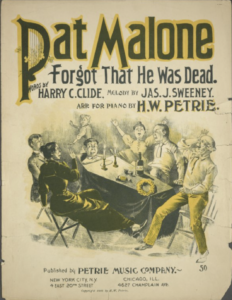
“Pat Malone Forgot That He Was Dead.” New York: Petrie Music Company (1895)
One particularly colorful Brooklyn Eagle article from 1900 recalls a “remarkable character” of “vast proportions, yet lively as a cricket when participating in the intricacies of an Irish reel or jig,” Connacht-born Peggy Murphy, and her pet goat, Billy, who resided in Irishtown in the mid-1860s––both of whom were said to have frequently imbibed:
“The goat, too, was on intimate terms with the men who made the sweet poteen, and not being a follower of Father Matthew, Billy was never what you could call a perfectly sober goat. Sometimes the men gave him an overdose, just to see the capers he would cut up. On such occasions he was given a wide berth, for he possessed a pair of horns that were capable of doing great execution.”
Later, when Peggy (and, allegedly, her goat) were served with a warrant, “it was never served, for the reason that Dave Potter, who was somewhat of a politician…considered the best dancer in Irishtown…and possessed of great influence, had it quashed.” The article goes on to describe Irishtown as a “great place for bonfires, especially on election nights. With poteen abound, wagons, junk carts, signs of all kinds, cellar doors, coal boxes and barrels would be fed to the flames regardless of their value or their owners. It would not go well with anyone who would try to rescue them from the flames.” This same article notes that the aforementioned James “Ginger” Farrell operated his illegal whiskey distillery out of a former outhouse-turned-kindling-wood factory near the Navy Yard with Assemblyman Paddy Burns.[11]
In 1869, federal troops and agents sent by the Bureau of Internal Revenue launched one of their most aggressive raids in Irishtown, recruiting military personnel from the Navy Yard itself to seize and destroy nearby stills that proved capable of producing 250 barrels of alcohol daily (per the below mentioned NYT article, “one on Little street, said to belong to Samuel Warren; one in United States street near Little to Carey; one in United States street, near Little, to James Moran [listed in an ESB record as owning a legal liquor store and residing on Roosevelt St in Manhattan, site of the NYC draft riots, in 1851],[12] and another to McMahon, two in Plymouth street, said to be owned by Baydoks and Gaffney; one in Plymouth street near Gold, and one in Little street, the reputed owners of which are Orborne & Mullady, and Whiteford & Brady, respectively”––worthy of further investigation is the relationship of these illegal distilleries, if any, to the legally registered dealers they shared blocks or even buildings with, per the Hearne Directory). The daily output of the raided operations represented $5,000 in evaded license fees—equivalent to over $115,000 in today’s terms—while the tax implications were likely significantly higher, illustrating the substantial economic stake both for the government and for the surrounding community.[13] These ongoing clashes between residents and federal enforcers became known as the “whiskey wars;” an 1869 New York Times article detailed the raids as follows:
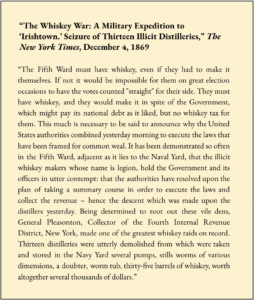
The sight of armed raids, smashed stills, and confiscated barrels left Irishtown deeply suspicious of any outsiders and embittered toward government authority. This distrust was so entrenched that the residents of Irishtown developed their own informal systems of law and order, sidestepping official channels altogether; community members enforced local standards through a combination of neighborhood vigilance and gang patrols, administering their own brand of justice and maintaining control in ways that official authorities rarely contested. This self-regulated order became a hallmark of Irishtown’s defiance and contributed to the distinct identity of the neighborhood well into the 20th century, when the physical landscape began to shift with the expansion of the Navy Yard and construction of the Manhattan Bridge.
[1] “THE PROHIBITORY LAW.; AN ACT For the Prevention of Intemperance, Pauperism and Crime,” The New York Times, April 4, 1855. https://www.nytimes.com/1855/04/06/archives/the-prohibitory-law-an-act-for-the-prevention-of-intemperance.html
[2] Paul Aaron and David Musto, “Temperance and Prohibition in America: A Historical Overview,” in Alcohol and Public Policy: Beyond the Shadow of Prohibition, National Research Council (US) Panel on Alternative Policies Affecting the Prevention of Alcohol Abuse and Alcoholism; ed. Moore MH & Gerstein DR, Washington D.C.: National Academies Press (US); 1981. https://www.ncbi.nlm.nih.gov/books/NBK216414/
[3] “Sachems and Sinners: An Informal History of Tammany Hall,” Time Magazine, August 22, 1955. https://time.com/archive/6609871/sachems-sinners-an-informal-history-of-tammany-hall/
[4] Mott Wright, Hearne’s Brooklyn City Directory for 1853-1854 (Brooklyn: Henry R. & William J. Hearne, 1853), Google Books
[5] “Commander Chandler’s Crusade: Against the Smugglers of Vile Irishtown Whiskey,” The Brooklyn Eagle, March 12, 1886. https://bklyn.newspapers.com/image/50463264/?match=1&terms=whiskey%20irishtown
[6] “The Whisky Frauds: Further Developments. Additional Seizures of Distilleries and Whisky. Devlin and Tilton,” The Brooklyn Eagle, November 19, 1866. https://bklyn.newspapers.com/image/541727549/?match=1&terms=john%20devlin; EISB Acct. Nos. 13841, 17217, 23400, and 25781, John Devlin, Test Book, Ancestry.Com. New York, Emigrant Savings Bank Records, 1850-1883 [database on-line], Provo, UT, USA: Ancestry.com Operations Inc., 2005.
[7] “The Whisky Frauds: The Defence Make Some Offers. Argument by Messrs. Stoughton and Evarts. A Curious Witness,” The Brooklyn Eagle, February 1, 1868. https://bklyn.newspapers.com/image/541823233/?match=1&terms=john%20devlin
[8] See footnote 6.
[9] “The Great Whisky Case: Trial of John Devlin for Defrauding the Revenue,” The Brooklyn Eagle, January 29, 1868. https://bklyn.newspapers.com/image/541823079/?match=1&terms=john%20devlin
[10] Words by Harry C. Clide. Melody by Jas. J. Sweeney. Arr. for Piano by H.W. Petrie, “Pat Malone Forgot That He Was Dead.” New York: Petrie Music Company (1895). Via Box 054, Item 098, Lester S. Levy Sheet Music Collection, Johns Hopkins University. https://levysheetmusic.mse.jhu.edu/collection/054/098
[11] “Sad Tale of Peggy’s Goat: Michael J. Shay Closes His Interesting Reminiscences of Life in Old Irishtown With a Humorous Account of Billy’s Destructive Drunk and Its Dire Results,” The Brooklyn Eagle, January 21, 1900. https://bklyn.newspapers.com/image/50381956/?match=1&terms=ginger%20farrell
[12] New York, U.S., Emigrant Savings Bank Records, 1850-1883. Test Books, 1851, pg. 9, line 24. https://www.ancestrylibrary.com/imageviewer/collections/8760/images/ESB_4-0026?treeid=&personid=&queryId=96aa97c7-f479-4a67-99a4-55f82845f794&usePUB=true&_phsrc=Xwj1103&_phstart=successSource&pId=214160
[13] “The Campaign in Irishtown: Operations Suspended – An Impromptu mass Meeting, “ The Brooklyn Eagle, December 4, 1869. https://bklyn.newspapers.com/image/50505654/?match=1&terms=whiskey%20irishtown