County Mayo
By Tim Morrissey, Glucksman House, New York University
©Tim Morrissey, 2024. All rights reserved.
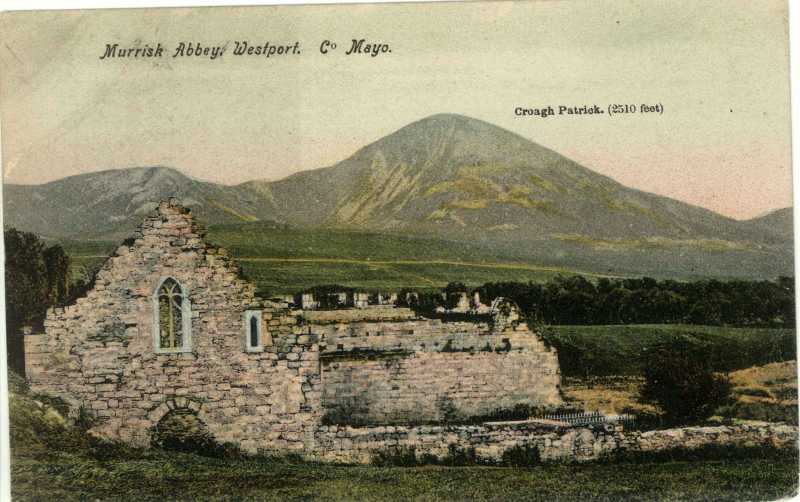
County Mayo in the 1840s and 50s was a bilingual region with drastic differences in quality of life between the populations of its largest towns – Castlebar, Westport, and Ballina – and its rural, often Irish-speaking regions such as Achill island and Muskree. At large, Mayo was often regarded by the British government as particularly difficult to control. It housed one of the ancestral castles of Gráinne Ní Mháille (Grace O’Malley), and was the point of invasion by French forces during the 1798 rebellion.[1]
One of the largest landowners in County Mayo were the Brownes, who held titles such as Earl of Altamont and Marquess of Sligo, residing at Westport House and acquiring their wealth from plantations in Ireland and absentee slaveholding in Jamaica.[2] The Brownes, one of the ancient tribes of Galway, are direct descendants of Gráinne Ní Mháille; although Catholic for generations, they converted to Protestantism by the end of the 18th century. Denis Browne, sheriff and politician, was well known for his strict punishment of rebels during the 1798 rebellion, earning the Irish language nickname, Donnchadh an Rópa, (Denis the Rope).[3] His brother, John Browne, was named first Marquess of Sligo after the Act of Union, and was succeeded by his son Howe Peter Browne upon his death in 1809.[4]
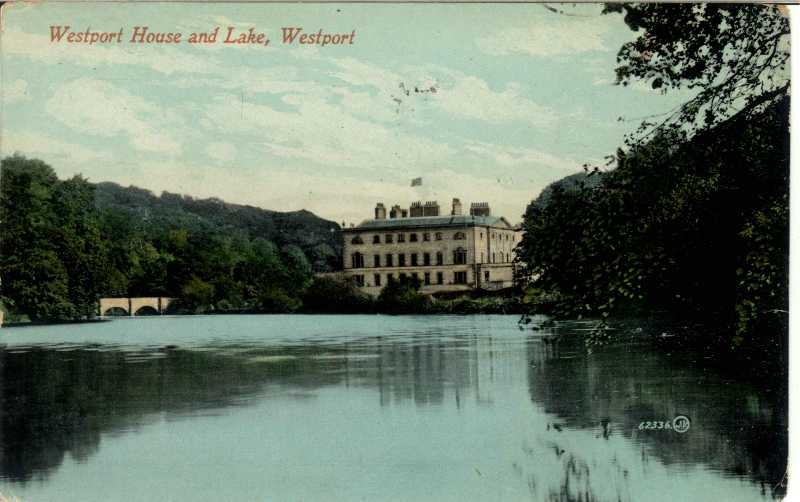
As Lord Sligo, Howe Peter Browne was well known for his roguery and womanizing, even “plundering” Greece of the columns of Agamemnon alongside Lord Byron in 1812 (later discovered in the basement of Westport House).[5] He went on to serve as Governor of Jamaica from 1834-1836, where, along with his wife Hester Catherine, the daughter of the Governor of Galway, he championed the abolition of slavery on the island.[6] Howe Peter Browne and Lady Hester are remembered for their exceedingly humanitarian response to the Famine, importing grain and potatoes, building a hospital to care for the sick, and going into debt to feed the people under their care.[7] Brown died in 1845, but famine relief work continued under the stewardship of Lady Hester. Because of this, the population of the town of Westport only declined from 4,365 to 4,114 people during the Famine, a drastically different outcome from the fate of rural County Mayo, which lost on average a quarter of its population to starvation and emigration.[8]
In contrast, there was a cataclysmic change during the Famine years reflected in the quality of housing in rural Co. Mayo between 1841 to 1851. The percentage of families living in fourth class housing, comprised largely of one room mud hovels, dropped from an average of over 65% to an average of well under 20%, and the percentage of families living in third class housing comprising one to four room stone and mud cottages shifted at the same rate in the opposite direction. The changes in housing in second and first classes are comparatively imperceptible.[9] It was thus the poorest of the poor that disappeared through death and emigration in rural county Mayo.
The landscape of west Mayo is dominated by Croagh Patrick, long a pilgrimage site for the religious, and visible from Westport. On the opposite side of Croagh Patrick, hundreds of starving people marched from the town of Louisburg through the Doolagh valley towards Delphi seeking food, many of them dying during the journey.[10] A majority of the population of rural Mayo was Irish-speaking, and church services in rural Mayo after the Famine were often held twice every Sunday in Irish and then English.[11] A national linguistic survey in 1851 determined that 66% of the population of Mayo county were Irish speakers.[12]
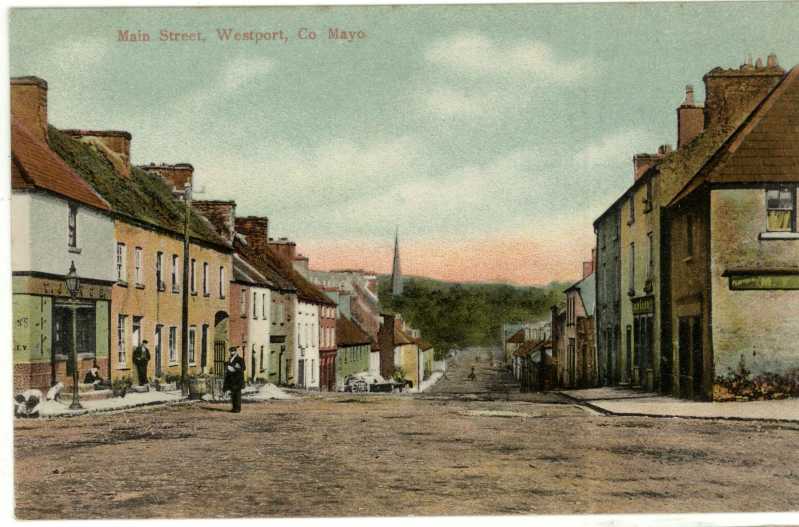
Ballina and Westport served the Mayo region, and especially their larger neighbor Castlebar, as ports to the Atlantic ocean. The town of Westport is divided between a main village center with a river running through its heart, and a quay on the Clew Bay which at the time serviced six vessels.[13] Within Westport, a large brewery, around half the size of the village itself, existed on the border between the village and the demesne of Lord Sligo, which culminates at Westport House overlooking a lough that leads into Clew Bay. Within these three dense villages, linen, tobacco and snuff, and the brewing of beer were the primary industries.
The Morgan siblings, Thomas, Edward, and Maria, all emigrated from Westport to Brooklyn’s Irishtown in the late 1840s and early 1850s. Edward and Maria travelled from Liverpool on the David Cannon to New Orleans, about 18 months apart in 1853. Thomas emigrated on the Adriatic in 1854. The three siblings lived with their mother Mary Harrington Morgan at 89 Gold Street until 1855. Edward, a gilder, then moved to 187 Water Street, and Thomas to 172 Water Street, where he switched from being a store clerk to a higher skilled printer. Mary Jennings emigrated on the Australia from Castlebar to Irishtown in 1855. Siblings Rosa and Samuel H. Coleman hailed from Crossmolina, County Mayo.[14] They worked at the corner of Little and Water streets at the Commercial and Mathematical School, also known as O’Brien’s School, where Samuel was a principal and Rosa a schoolteacher. Samuel likewise ran meetings for the Cosmopolitan Literary Club, an Irish-American debate and poetry reading group for which he served as an editor until his death in 1858.[15]
[1] Samuel Lewis. “County Mayo – Topographical Dictionary of Ireland (1837).” Library Ireland, n.d.
[2] Liam Hogan. “Opinion: Following the money – Irish slave owners in the time of abolition”. TheJournal.ie, 27 July 2014. Retrieved 26 December 2024.
[3] James Quinn. “Browne, Denis.” Dictionary of Irish Biography, October 2009. https://www.dib.ie/biography/browne-denis-a1021.
[4] “Browne family tree”. Thesilverbowl.com. Retrieved 26 December, 2024.
[5] Turtle Bunbury. LORD SLIGO’S PLUNDER OF ANCIENT GREECE. History Ireland. Vol. 22. HISTORY PUBLICATIONS LTD, 2014.
[6]Anne Chambers. CHAMPION OF THE SLAVES: Howe Peter Browne, 2nd Marquess of Sligo (1788–1845). History Ireland. Vol. 26. History Publications Ltd, 2018.
[7]Anne Chambers. The Great Leviathan : The Life of Howe Peter Browne, 2nd Marquess of Sligo, 1788-1845. Stillorgan, County Dublin, Republic of Ireland: New Island, 2017.
[8] Population, Rural. “The Great Irish Famine Online,” Geography Department, University College Cork and Department of Culture, Heritage and the Gaeltacht. Retrieved 26 December, 2024.
[9] Families and Housing, “The Great Irish Famine Online,” Geography Department, University College Cork and Department of Culture, Heritage and the Gaeltacht. Retrieved 26 December, 2024.
[10] “Doolough”. The Famine in Mayo 1845-1850. Mayo County Library. p. 7. Retrieved 26 December, 2024.
[11] Samuel Lewis. “Achill, a parish – Topographical Dictionary of Ireland (1837).” Library Ireland, n.d.
[12] John T. Ridge, “The Hidden Gaeltacht in Old New York – Nineteenth Century Preaching in the Irish Language,” New York Irish History Roundtable. Vol. 6, 1991-1992.
[13] Samuel Lewis. “Westport – Topographical Dictionary of Ireland (1837).” Library Ireland, n.d.
[14] Death notice for Samuel H. Coleman. “Died.” The Brooklyn Eagle (Brooklyn), Aug. 25th, 1858. p. 3.
[15] “Cosmopolitan Literary Club,” The Brooklyn Eagle (Brooklyn), Nov. 21st. 1856. p. 3.