by Clare Martin, Glucksman Ireland House, New York University
© Clare Martin, 2024. All rights reserved.
Among those Irish living in Brooklyn’s Irishtown in the mid-19th century with savings accounts in the Emigrant Savings Bank, six had emigrated from County Monaghan; tied for the most from any one county
In the mid-nineteenth century, Monaghan was a county with notable religious diversity, small-scale farms, and robust manufacturing in several fields. The average farmer in Monaghan was likely to work land that he did not own—there were a few larger estates with absentee landlords who lived in Dublin or London, but it was more common for Monaghan farmers in the 1830s and 40s to live on a smaller estate with its owner.[1] Ann Smith, who emigrated to New York in 1844, is one of many residents of Monaghan to have lived as a tenant. This kind of arrangement can be explained by the installation of Scots-Irish settlers in the county during Cromwell’s reign.[2] In terms of the nature of the land, a combination of wet soil and small farms incentivized farmers to carry materials on foot rather than using livestock to help them transport items. This made the farmer’s life difficult; in 1837, there was “no county in Ireland where manual labor [was] more employed.”[3] Some emigrants from Monaghan to Irishtown, such as James Connolly, Emigrant Savings Bank account number 1187, continued their work as farmers in New York after they emigrated.
Aside from farming, Monaghan residents found work in manufacturing—chiefly in lace, linen, tanning, and iron.[4] These industries were specific to certain towns, so local culture within Monaghan was strongly influenced by the products that were made in each.[5] In terms of artisanal prowess, perhaps the most iconic manufactured good from County Monaghan is Carrickmacross lace, made in the town of the same name as early as 1820 and earning international relevance that remains to this day.[6] This uniquely delicate lace notably held favor with Irish and non-Irish shoppers in the United States, garnering a transatlantic reputation that earned it a spot in the Brooklyn department store of Abraham and Straus as well as in the weddings of wealthy Brooklyn and Long Island brides.[7] Residents of Carrickmacross, like the Maxwells, would have seen young women learning and practicing the lace trade on Mullinary Road, a block away from the main street.[8]
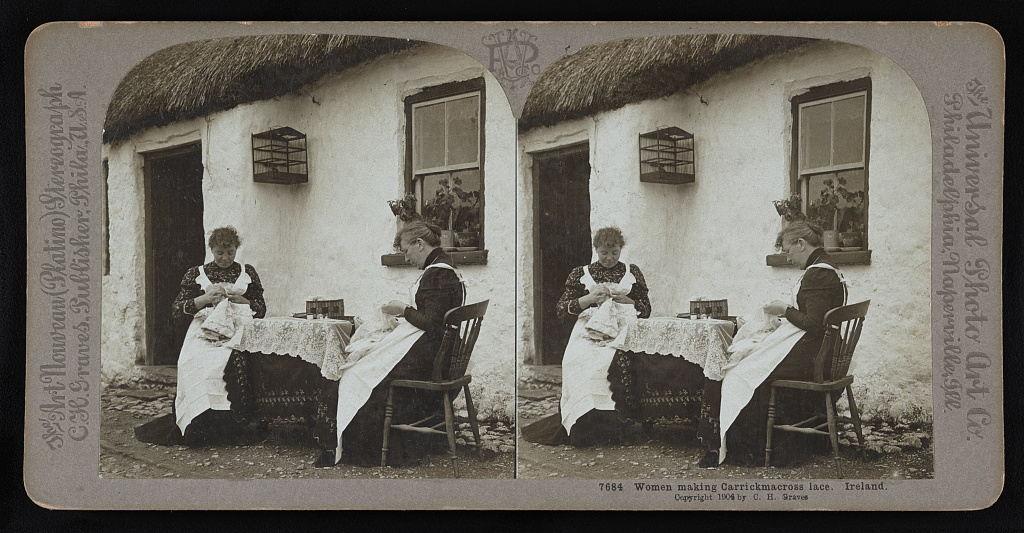
Women making Carrickmacross lace, Co. Monaghan, Ireland, 1904. Carleton H. Graves. Library of Congress Prints and Photographs Division Washington, D.C. https://hdl.loc.gov/loc.pnp/stereo.1s28053.
Regional cultures in County Monaghan were also defined by the religious diversity therein. In addition to the expected presence of the Roman Catholic Church and the Church of Ireland, several of the more populous towns in the county, including Monaghan itself, had at least one Methodist and one Presbyterian place of worship.[9]
[1] Samuel Lewis. “Monaghan Agriculture” in A Topographical Dictionary of Ireland, 1837. Accessed 2 December 2024. https://www.libraryireland.com/topog/M/Monaghan-Agriculture.php.
[2] “Monaghan Agriculture”.
[3] “Monaghan Agriculture”
[4] “Monaghan Manufacturing” in A Topographical Dictionary of Ireland (1837). Accessed 2 December 2024. https://www.libraryireland.com/topog/M/Monaghan-Manufacturing.php.
[5] “Monaghan Manufacturing.”
[6] Phyllis Ajoy Sarkar et al. “Carrickmacross Lace” in The Fairchild Books Dictionary of Textiles. Bloomsbury, 2021.
[7] “Lace Making in Erin,” The Brooklyn Citizen, Jul. 28, 1889, p.10. Accessed 2 December 2024. https://bklyn.newspapers.com/image/543645338/?match=1&terms=carrickmacross; “Embroideries Half Price,” The Brooklyn Citizen, Feb. 4, 1900, p.1. Accessed 2 December 2024. https://bklyn.newspapers.com/image/541900300/?match=1&terms=carrickmacross; “Case-Elder Wedding,” The Brooklyn Daily Times, May 19, 1917, p.6. Accessed 2 December 2024. https://bklyn.newspapers.com/image/556178452/?match=1&terms=%22“carrickmacross%20lace”%22.
[8] “Carrickmacross, County Monaghan,” in The Belfast and Ulster Towns Directory for 1910 (1910). Accessed 2 December 2024. https://www.libraryireland.com/UlsterDirectory1910/Carrickmacross.php.
[9] “Monaghan” in The Belfast and Ulster Towns Directory for 1910 (1910). Accessed 2 December 2024. https://www.libraryireland.com/UlsterDirectory1910/Monaghan.php; “Clones, County Monaghan” in The Belfast and Ulster Towns Directory for 1910 (1910). Accessed 2 December 2024. https://www.libraryireland.com/UlsterDirectory1910/Clones.php.