By Gracelyn Barmore-Pooley, Glucksman Ireland House, New York University
© Gracelyn Barmore-Pooley, 2024. All rights reserved.

Eneas E. Carlmon, the name that Eneas Cannon enlisted under, in the New York Civil War Muster Roll Abstracts, 1861-1900, [database on-line]. Lehi, UT, USA: Ancestry.com Operations, Inc., 2011.
Eneas emigrated to the United States on the ship Roscius in 1844, through Liverpool and then to New York City.[2] He was the oldest of four siblings, with a younger sister Rosana (28 in 1855), and younger brothers John and Patrick (25 and 23 in 1855, respectively). He also lived with his father, John, in 1855. Eneas—whose name is the Irish word for praise– worked as a bookseller, as did his brother John, and opened an account at the Emigrant Savings Bank in 1855.[3]
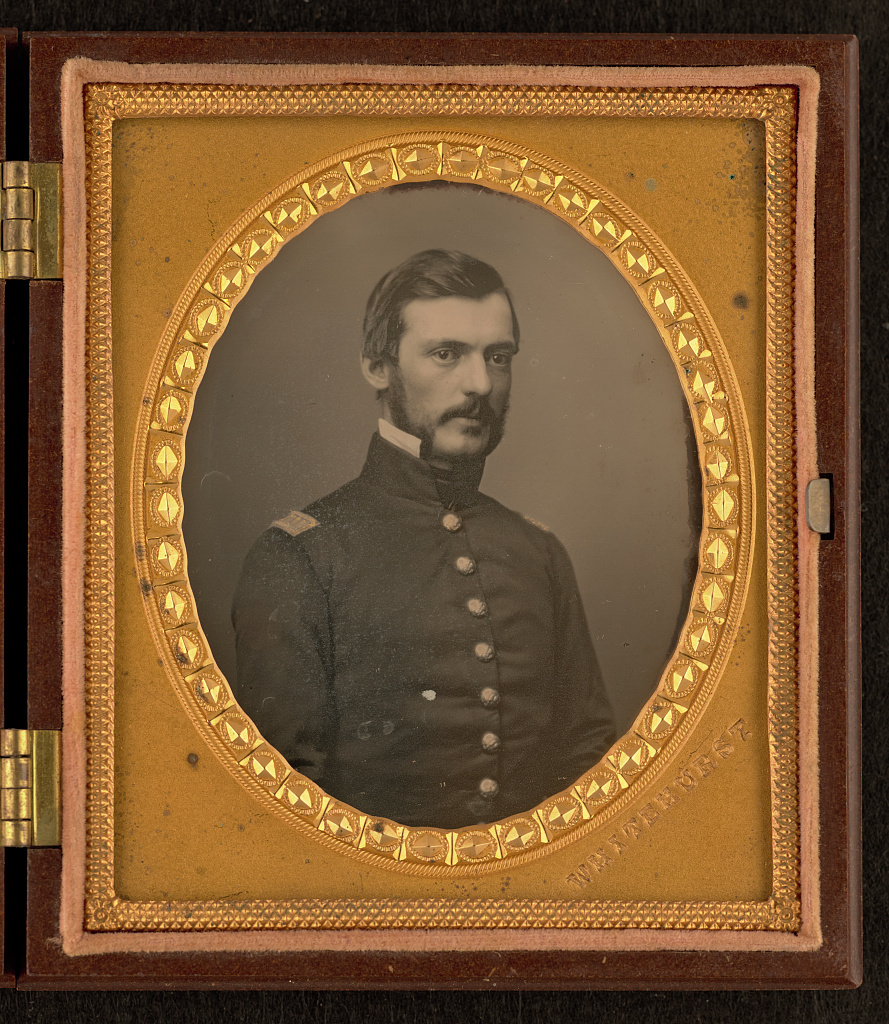
An unidentified soldier in a Union Uniform, similar to one Eneas Cannon may have worn. United States, [Between 1861-1865] Photograph. https://lccn.loc.gov/2021653189
Cannon was naturalized on October 16th, 1858, fourteen years after he arrived in the United States.[6] On this occasion, his name was spelled as “Aeneas,” and he still resided in Brooklyn. Subsequently, he can be followed to the 1860 Federal Census, where he was recorded at age 41 as a vender at Bellevue Hospital.[7] It is unclear whether he was working at the hospital or lived there as a patient. At times, Bellevue’s facility was used by the Bureau of Medical and Surgical Relief for the “Out-Door Poor,” which Cannon may have been utilizing.[8] The hospital may have been considered “group quarters,” by the census-taker, with Cannon fitting the description of a member of a “noninstitutionalized population,” living in places like military barracks or long-term-care hospitals.[9] He may have lived in the “private apartments of the main building” in which those “employed at the institution go to bed.”[10] In 1857, a new wing of the hospital for male patients was reported, with 758 patients “already on the premises.”[11] In 1858, a man named James O’Brien, who had been employed at a different hospital on Blackwell’s Island, was arrested under suspicion of arson and an attempt to burn Bellevue down.[12] Despite the criminal nature of this report, it indicates that Irish people were employed at Bellevue at the time. The hospital was lauded in the Third Annual Report of the Commissioners of Public Charities and Correction for the year 1862 for its “devotion to the welfare of the poor and unfortunate,” alongside its contributions to the war effort.[13]
However, Bellevue was not always a safe or clean place to be. A few years earlier, in 1860, the Commissioners of the Department of Public Charities and Commissions investigated the case of an infant, Mary Conner, who was “mutilated by rats” at the hospital.[14] The rats at the hospital were “a bold and reckless race,” and did not hesitate to “come forth from their hiding-places and scamper about even in the presence of men in high position.”[15] The rats were described as having “full possession of the building,” given the proximity of the site to the East River that enabled myriads of rats each evening to “swarm at the water side after nightfall, crawl through the sewers,” and enter the building.[16] The mother of the baby was a thirty-one-year-old unmarried “servant girl,” born in Dublin but in the U.S. for eight years.[17] She was “feeble and listless,” and stated that “it did not make any difference to her whether the child was dead or alive.”[18] This reveals some of the dangers for unmarried Irish women at the time.
Regardless, several pages of the census were dedicated to Bellevue Hospital. The majority of the inhabitants were Irish, with pages of women listed as “domestics” mostly coming from Ireland.[19] However, some domestics and nurses were from places as varied as New York, England, Switzerland, Sweden, Russia, and Poland. More diversity existed in the occupations of men listed in the census at Bellevue, including laborers, longshoremen, carpenters, orderlies, firemen, cooks, domestics, gaolfitters, gardeners, and apothecaries. Similarly, the majority of men were Irish, but American, English, and Eastern European men all were listed.[20] All of the inhabitants of the hospital were unmarried. Eneas either worked or lived among them for a time.

Genl. Meagher at the Battle of Fair Oaks Va., June 1st, 1862. Published by Currier & Ives, c1862. Public Domain.
Eneas enlisted in the Union Army on the 24th of September 1861, under the name “Eneas E. Carlmon.”[21] In the remarks of his Muster Roll, it describes him as “borne as” both Daneas Cannon and Eneas Cannon, and as “born in Ireland, age 40 years,” with a residence in Brooklyn on Hudson Avenue. He was in the 69th Infantry, Company B, which was known as the “Irish Brigade” and led by General Thomas F. Meagher.[22] Upon the first deployment of the 69th, they carried an “emerald green flag on which were embroidered in gold Irish symbols such as the harp, sunburst, and shamrock.”[23] He was deployed to the front in Virginia and was captured as a prisoner of war on June 15th, 1862.[24] The most recent battle he would have fought in was the Battle of Seven Pines, also known as the Battle of Fair Oaks, fought from May 31 to June 1, 1862.[25] He died in captivity on the 10th of July 1862, from disease.[26] He was buried in Richmond National Cemetery, and had the rank of Private at the time of his death.[27]
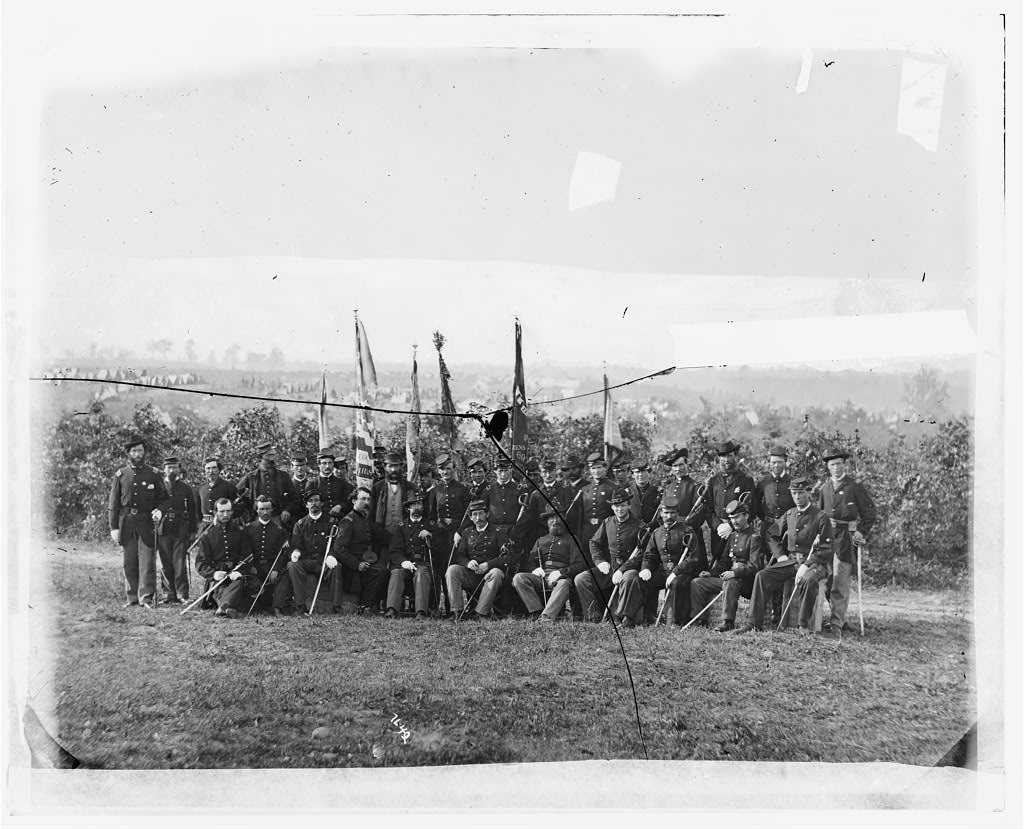
A photograph of Lt. Col. James J. Smith and officers of 69th New York Infantry Irish Brigade. At the time that Eneas Carlmon was serving, James J. Smith was a first lieutenant and adjutant. United States, [Between 1862 and 1865] Photograph. https://www.loc.gov/item/2018672422/
The journey of the rest of Eneas’s family is difficult to trace. However, in the 1923 death record of an Edward Clare in Michigan, a Rosana Canon born in Ireland is listed as his mother, married to a John Clare.[28] Rosana seems to have married and moved to Michigan with her husband, starting a new life away from New York City. Perhaps in her travels, she made it down to Virginia to visit the grave of her older brother. Eneas may have been buried among other members of the Irish Brigade, surrounded as he was, at various points in his life, by his countrymen.
[1] Askaboutireland.ie Griffith’s Valuation Record Information, “John Cannon,” Donegal, Kilmacrenan, Millford, Sheet No. 45, Act 15 & 16, (1858). https://www.askaboutireland.ie/griffith-valuation/index.xml?action=doNameSearch&familyname=cannon&firstname=john&offset=0&countyname=DONEGAL&parishname=&unionname=&baronyname=&totalrows=31&PlaceID=0&wildcard=on
[2] EISB Acct. No. 9889, Eneas J Cannon, Test Book, Ancestry.Com. New York, Emigrant Savings Bank Records, 1850-1883 [database on-line], Provo, UT, USA: Ancestry.com Operations Inc., 2005.
[3] “What Is Aeneas in Irish?” Ireland. Accessed November 11, 2024. https://ireland101.com/what-is/aeneas/irish.
[4] Eneas J Cannon, Household 60, Families 261-164, King’s County (Brooklyn City), Ward 5, ED 1, p. 14. Ancestry.com. New York, State Census, 1855 [database on-line]. Provo, UT, USA: Ancestry.com Operations, Inc., 2010.
[5] “Plate 3: Map bounded by East River, Brooklyn Navy Yard, York Street, Bridge Street,” Image ID 1268419. New York Public Library Digital Collections.
[6] Aeneas J Cannon, 16 October 1858, Ancestry.com. U.S., Naturalization Record Indexes, 1791-1992 (Indexed in World Archives Project) [database on-line]. Lehi, UT, USA: Ancestry.com Operations, Inc., 2010.
[7] Eneas Cannon, Household 9, New York County, Ward 21, ED 5, p, 49. Ancestry.com. United States, Federal Census, 1860 [database on-line]. Provo, UT, USA: Ancestry.com Operations Inc., 2013.
[8] “Historical/Biographical Note,” Bellevue Hospital Medical College Records, 1861-1898. The Lillian and Clarence de la Chapelle Medical Archives, NYU Health Sciences Library. https://archives.med.nyu.edu/collections/bellevue-hospital-medical-college-guide-records
[9] Anderson, Margo J., Citro, Constance, and Salvo, Joseph J., eds. Encyclopedia of the U.S. Census: From the Constitution to the American Community Survey. Washington: CQ Press, 2011, 269. https://ebookcentral.proquest.com/lib/nyulibrary-ebooks/reader.action?docID=825151&ppg=294
[10] “Rats at Bellevue Hospital,” New York Times, April 27. 1860, p. 8. The New York Times Archives.
[11] “New York City,” New York Times, Oct, 30, 1857, p. 3. ProQuest Historical Newspapers.
[12] Police Intelligence, “Suspicion of Arson- An Attempt to Burn the Bellevue Hospital,” The New York Herald (1840-1865) Feb 25, 1858, p. 5. ProQuest Civil War Era
[13] “Third Annual Report of the Commissioners of Public Charities and Correction,” New York Daily Tribune (1842-1866) Mar 14, 1863, p. 2. ProQuest Historical Newspapers.
[14] “Rats at Bellevue Hospital,” New York Times, April 27. 1860, p. 8. The New York Times Archives.
[15] Ibid.
[16] Ibid.
[17] Ibid.
[18] Ibid.
[19] Eneas Cannon, Household 9, New York County, Ward 21, ED 5, p, 49. Ancestry.com. United States, Federal Census, 1860 [database on-line]. Provo, UT, USA: Ancestry.com Operations Inc., 2013.
[20] Ibid.
[21] Eneas E Carlmon, Ancestry.com. New York, U.S., Civil War Muster Roll Abstracts, 1861-1900 [database on-line]. Lehi, UT, USA: Ancestry.com Operations, Inc., 2011.
[22]Civil War Archive. “Union Regimental Histories, New York,” accessed November 25, 2024. http://www.civilwararchive.com/Unreghst/unnyinf6.htm#69
[23] Virginia Calkins and Steve O’Brien, “The Fighting Irish of the Civil War.” Cobblestone, Vol. 15 (3), 1994.
[24] Eneas E Carlmon, U.S., Civil War Soldier Records and Profiles, 1861-1865 [database on-line]. Provo, UT, USA: Ancestry.com Operations Inc, 2009.
[25] Peninsulacampaign.com. “Seven Pines,” accessed December 3, 2024. https://www.peninsulacampaign.org/7pines.shtml
[26] Eneas E Carlmon, Ancestry.com. New York, U.S., Civil War Muster Roll Abstracts, 1861-1900 [database on-line]. Lehi, UT, USA: Ancestry.com Operations, Inc., 2011.
[27] Pvt Eneas E Carlmon, Ancestry.com. U.S., Find a Grave® Index, 1600s-Current [database on-line]. Lehi, UT, USA: Ancestry.com Operations, Inc., 2012.
[28] Rosana Canon, p. 224. Ancestry.com. Michigan, U.S., Death Records, 1867-1952 [database on-line]. Provo, UT, USA: Ancestry.com Operations, Inc., 2015.