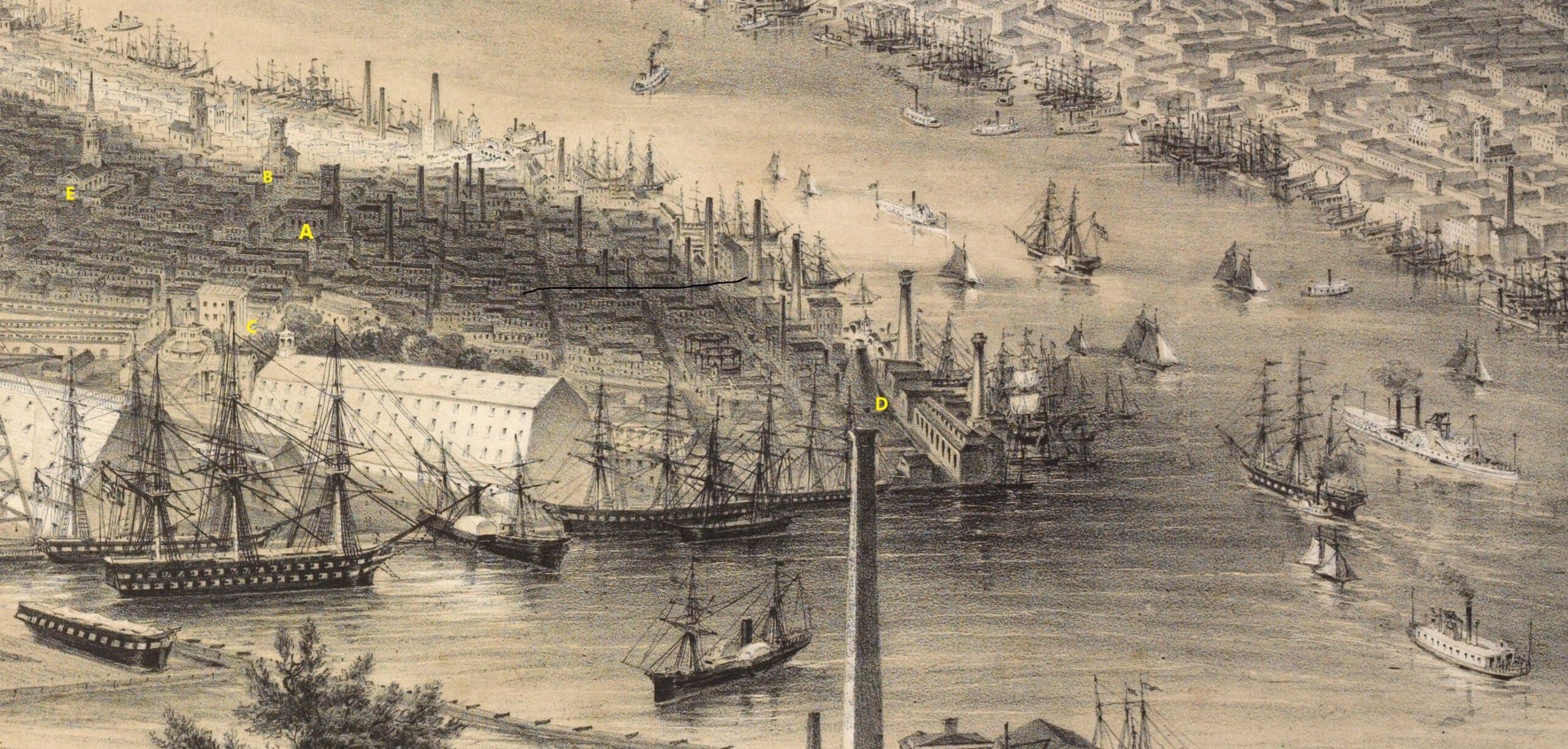
This bird’s eye view of Irishtown, part of Brooklyn’s Fifth Ward in 1855, reveals a densely packed, industrial, working class neighborhood sandwiched between the East River (right) and the Brooklyn Navy Yard (foreground). It was situated east of (A) St. Michael’s Episcopal Church on High Street between Gold and Hudson Avenue, (B) the Third Presbyterian Church on Jay Street corner of High Street, and (C) the Commandant’s Office at the entrance to the Navy Yard at the foot of Sands Street. Its riverfront terminus was (D) the Brooklyn Gas Light Company on Marshall Street near Hudson Avenue. The nearest Catholic Church was (E) St. James on Jay Street corner of Chapel Street in Brooklyn’s Fourth Ward. Detail from “City of Brooklyn, L.I. Taken from Rush Street” (1855), New York Public Library Digital Collections ID 1659387.
“Old Irishtown” – now known as Vinegar Hill – was a particular section of Brooklyn’s Fifth Ward and its geography was remembered by one resident who lived there as a boy in 1838:
When one stepped to the far sidewalk of Front Street, going to the East River at the corner of Jackson Street, now Hudson avenue, he had entered ‘Irishtown,’ and a few feet to the rear of such buildings as were situated on the left-hand side of Jackson Street going to the river, and thence to the Navy Yard wall, bounded the territory of ‘Irishtown’ proper. Gold street, which had been cut through to the river from Front street, was sand hills on both sides almost to Plymouth street, and open lots filled up the intervening territory on both sides of that street, so it will be seen that ‘Irishtown’ had no suburbs.[1]
Brooklyn 1855_Plate 3_Irishtown, NYPL
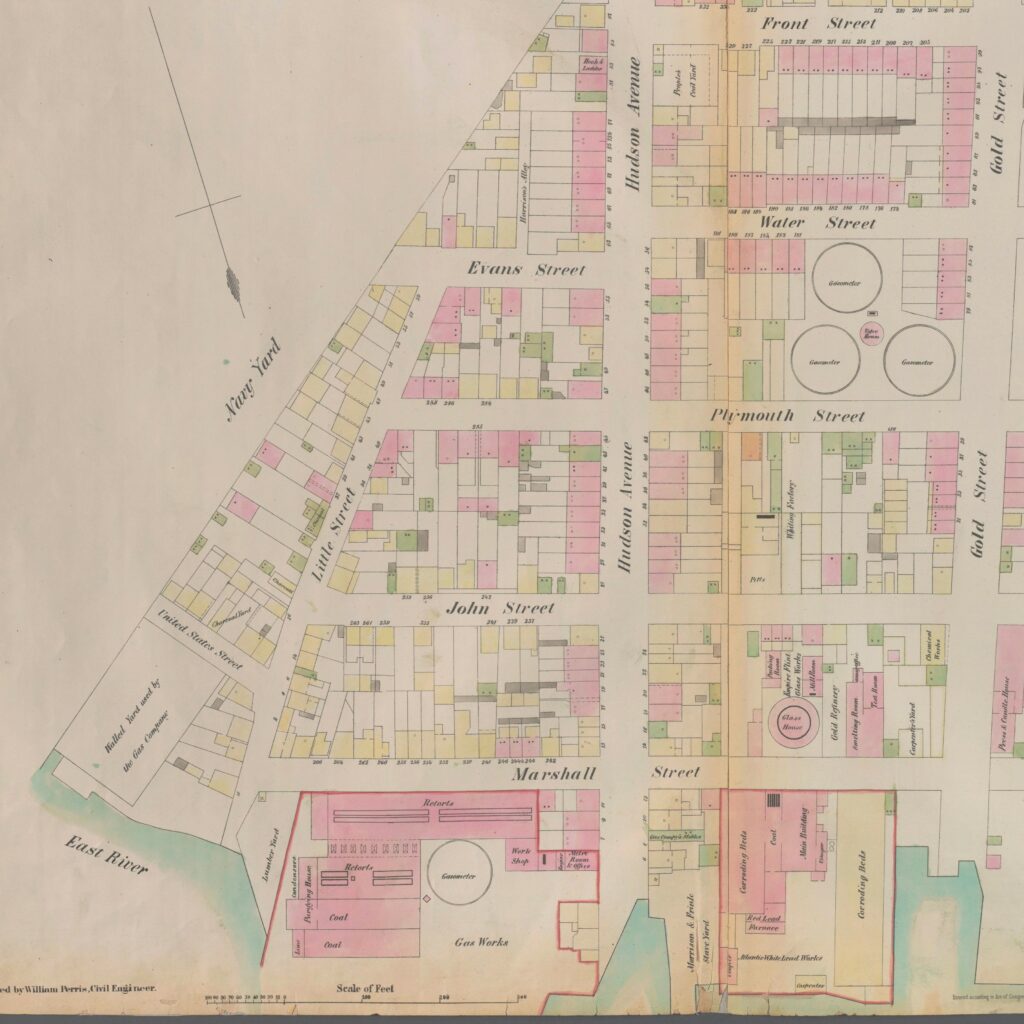
The population of Brooklyn’s Fifth Ward more than doubled between 1840 and 1870, from 7,415 to 17,400, largely due to the growing availability of industrial jobs adjacent to the Navy Yard.[2] The 1855 New York State Census found that the Irish-born population of this ward was 34.4%. As late as 1890, the Fifth Ward was ranked number one for the percentage of Irish-born in all of Brooklyn, even though it “was never the single most heavily Irish-born district in the city in any census year.”[3]
The following pages examine Brooklyn’s Irishtown, using a variety of nineteenth century primary sources that complement a dataset of 64 Irish-born residents who had accounts with the Emigrant Industrial Savings Bank in the 1850s and 1860s. The lived experience of the Irish women and men profiled and contextualized here challenges us to expand our understanding of the New York Irish — who lived across the East River in Manhattan — to include part of the neighboring City of Brooklyn.
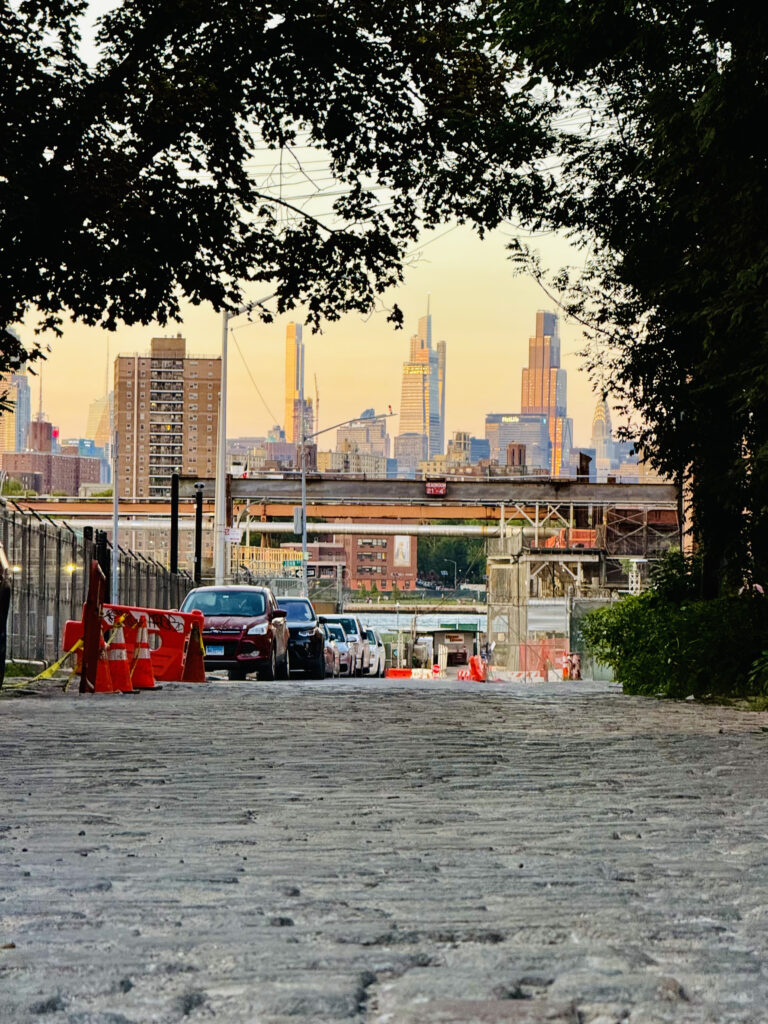
The Manhattan Skyline as viewed from the intersection of Hudson Ave and Evans St, Brooklyn, NY. September 3, 2024. Photograph by Eric Patrick Cameron with iPhone 15 Pro Max.
Among the unique Irish stories that have emerged from, or been extended by, this research are:
- Eneas J. Canon from Co. Donegal
- Patrick Shanahan from Co. Limerick
- The Morgans from Co. Mayo
- The Maxwells from Co. Monaghan
- Ann Smith from Co. Monaghan
- Edward Sullivan from Front Street, Brooklyn
- 45 Hudson Avenue
- 67 Hudson Avenue, Then & Now
- 77 Hudson Avenue, Then & Now
- 79 Hudson Avenue Murder
- 81 Hudson Avenue
- The Brooklyn Navy Yard
- The Glass Works of Brooklyn
- The Phoenix Oil & Candle Company, Gold Street between John & Marshall
- Bookstores and Bookselling in Mid-19th Century Brooklyn
- Liquor Dealers: Formal vs. Informal Economies
- St. Ann’s Catholic Church, 251 Front Street corner of Gold
- Pat Malone Forgot He Was Dead
Contributors to this Fall 2024 project at New York University are Professor Marion R. Casey, Gracelyn Barmore-Pooley*, Eric Cameron, Sandra Carey*, Maeve Carey-Kozlark, Clare Martin*, Timothy Morrissey*, and Mike Rivas Fernandez.
* indicates graduate students in Glucksman Ireland House’s M.A. in Irish and Irish-American Studies program .
[1] “’Irishtown’ A Memory, But 5th Ward is on Map,” Brooklyn Eagle, January 25, 1908, p. 8.
[2] John Disturnell, New York As It Was And As It Is (New York: D. Van Nostrand, 1876), p. 234
[3] Stephen J. Sullivan, A Social History of the Brooklyn Irish, 1850-1900 (PhD, Columbia University, 2013), p. 126