By Gracelyn Barmore-Pooley, Glucksman Ireland House, New York University
© Gracelyn Barmore-Pooley, 2024. All rights reserved.

A short walk from Irishtown and the Brooklyn Navy Yard is Commodore Barry Park, a ten-acre green space at Navy Street and Flushing Avenue that dates back to 1836 when it was known as City Park.[1] According to the Brooklyn Eagle, it had previously been a “morass covered with water all year around, and a favorite place for skating in Winter” for residents of the “First, Second and Fifth Wards.” [2]
The pond was eventually filled in as Brooklyn expanded; a citizens’ petition then transformed it into a park.[3] It was such a precious asset in an otherwise industrial neighborhood that a City ordinance was passed in 1846 to institute a $10 fine for anyone who, “in any manner”, injured “the Trees, Grass or Shrubbery in the City Park, or to the Fence or Gates surrounding the same.”[4]
By the 1870s, City Park was “an eyesore, and a place particularly dreaded at nightfall”. The area surrounding the park had deteriorated so much so that the park was “shunned by all except unfortunates, who came to sleep there on the grass because they had nowhere else to go.”[5] Renovations were undertaken in the summer of 1873 towards making City Park “an attractive resort for the people in the neighborhood who much need such a breathing space.” [6] However, because the site remained attractive to so-called “young loafers and ruffians” who vandalized the park, it was briefly proposed to make it a much-needed city market for the neighborhood instead.[7] Appropriations for maintenance of City Park continued to be limited. “There never has been any comprehensive effort to make a true park of it,” opined the Brooklyn Eagle in 1887, although “…the silver poplars of the City Park have grown exceedingly well.”[8]
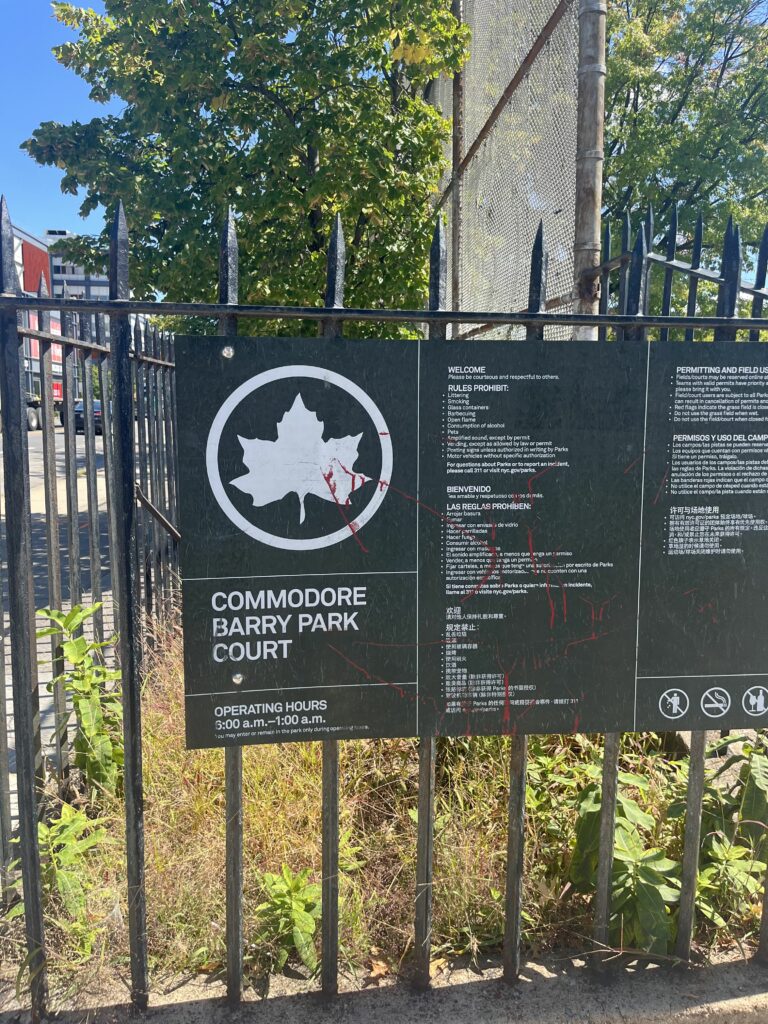
The nearby Navy Yard attracted a large workforce during World War I and World War II, changing the ethnic and racial character of the neighborhoods that hugged its walls.[9] When the City of New York (consolidated with Brooklyn since 1898) renamed the park in 1951, it chose to honor John Barry, known as the “father of the [United States] navy” and said to have helped found the Navy Yard before his death in 1803.[10]
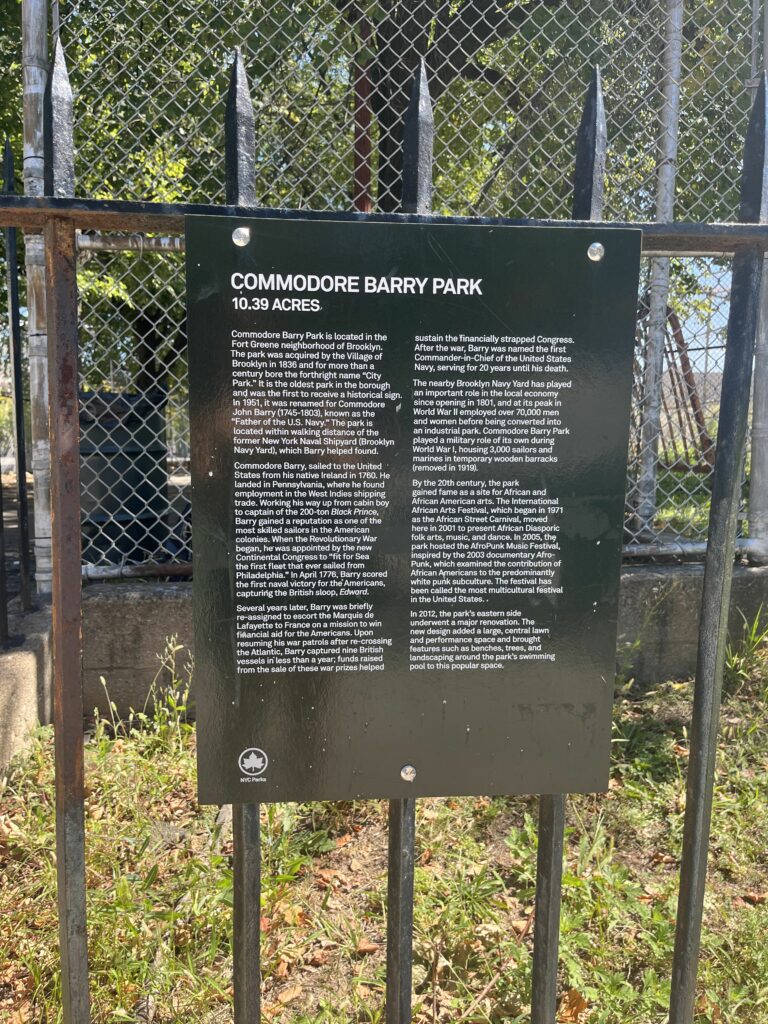
Commodore Barry Park is now the only tangible link to the many Irish who once lived in this section of Brooklyn. Its namesake was born at Ballysampson, Co. Wexford, and arrived in Philadelphia for the first time in 1762.[11] Barry was appointed as the first commissioned officer in the U.S. Navy in 1797 and was in command of the ship that scored the first naval victory for the Americans in the Revolutionary War, capturing the British sloop Edward.[12] Brother Aiden, a native of Co. Wexford like Barry and a member of a local Irish Catholic teaching order, the Franciscan Brothers of Brooklyn, was responsible for suggesting that the park be renamed for Barry “because of its proximity to the famous ‘Can do’ shipyard.”[13]In fact, John Barry had already been a very useful patriotic hero for Irish Americans who succeeded in erecting two statues of him, in Philadelphia’s Independence Square in 1907 and in Franklin Park in Washington, D.C. in 1914.[14]
On September 14, 1959 it was Brooklyn’s turn when City Park was officially renamed. Civic leaders as well as the Ancient Order of Hibernians participated in “Barry Day,” a large event that included a two-hour concert with performances by John Feeny, a famous Irish tenor, and the U.S. Navy Band.[15]
[1] NYCgovparks.org. “Commodore Barry Park. “Accessed December 10, 2024. https://www.nycgovparks.org/parks/commodore-barry-park/history
[2] “The City Park,” Brooklyn Eagle, August 19, 1873, p. 4
[3] “The City Park,” Brooklyn Eagle, August 19, 1873, p. 4
[4] “A Law to Prevent Injuries to the Trees,” Brooklyn Eagle, June 5, 1846, p. 2
[5] “The City Park,” Brooklyn Eagle, August 19, 1873, p. 4
[6] “The City Park,” Brooklyn Eagle, August 19, 1873, p. 4
[7] “Our Parks,” Brooklyn Eagle, February 2, 1880, p. 4
[8] “A View of Navy Street,” Brooklyn Eagle, March 6, 1887, p. 10
[9] Margaret Lattimer, “Brooklyn” and Arnold Markoe, “Brooklyn Navy Yard”, Encyclopedia of New York City, ed. Kenneth T. Jackson (Yale University Press, 2010), pp. 171, 180-181
[10] “To Honor ‘Father of Navy,’” New York Times (New York), September 7, 1929, p. 21. ProQuest Historical Newspapers.
[11] “Father of the American Navy,” New York Times (New York), December 24, 1933, p. BR4. ProQuest Historical Newspapers; William E. Watson & Eugene J. Halus Jr., Irish Americans: The History and Culture of a People (Bloomsbury, 2014), 6.
[12] NYCgovparks.org. “Commodore Barry Park. “Accessed December 10, 2024. https://www.nycgovparks.org/parks/commodore-barry-park/history
[13] “Park to be Renamed,” Greenpoint Weekly Star (Brooklyn, New York), September 11, 1959, p. 9. Brooklyn Newspapers.
[14] Marion R. Casey, The Green Space: The Transformation of the Irish Image (New York University Press, 2024), pp. 58-60
[15] “New Park Name OK’d,” Brooklyn Eagle (Brooklyn, New York), April 25, 1959, p. 3. Brooklyn Newspapers; “Park to be Renamed,” Greenpoint Weekly Star (Brooklyn, New York), September 11, 1959, p. 9. Brooklyn Newspapers; “Dedicate Barry Park,” Brooklyn Record (Brooklyn, New York), September 5, 1959, p. 8. Brooklyn Newspapers.