By Gracelyn Barmore-Pooley, Glucksman Ireland House, New York University
© Gracelyn Barmore-Pooley, 2024. All rights reserved.
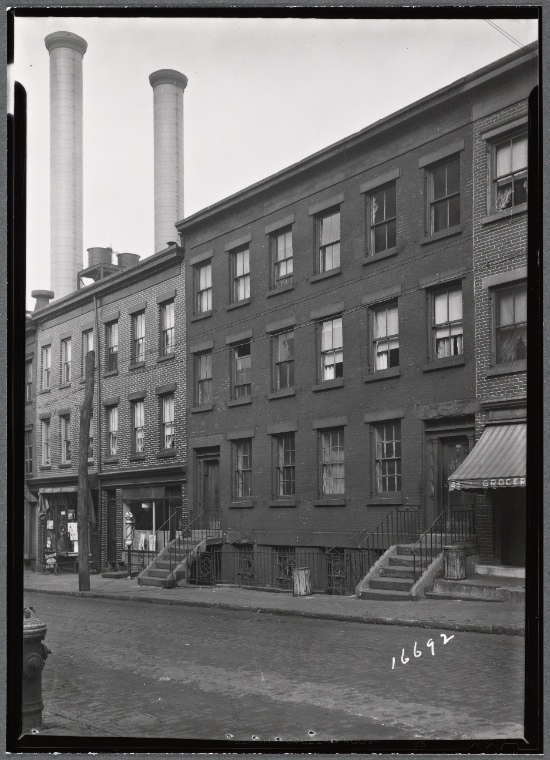
Hudson Avenue from photographs taken by the New York City Tenement House Department, 1936. 45 Hudson is the farthest left, from the New York Public Library Digital Collections, Dig ID: 3984906.
45 Hudson Avenue was a brick dwelling in Irishtown, listed in William Perris’ maps as a second class dwelling with a store under, and a slate or metal roof that was not coped.[1] It was at the edge of the block, sharing a corner with Plymouth Street. Eneas J Cannon, an account holder at the Emigrant Savings Bank, is listed under the name “Enese Canon,” living with his family there alongside three other families in the 1855 New York State Census.[2] He lived with all the members of his family, alongside three boarders. No occupations are listed for the father, Patrick, or Rosana, but Eneas and his brother John were listed as booksellers. Eneas and Patrick were marked as naturalized, but the rest of the family were listed as aliens. All were listed as having lived in the city for five years, meaning Eneas may have lived somewhere else from 1844 to 1850 before returning to New York City, perhaps to reunite with the rest of his family. Eneas was listed as 38 in the 1855 census, ten years older than his closest sibling. Two of the boarders were from Ireland. Ellen Donahoe was an eighteen-year-old seamstress from Ireland, also listed as being in the country for five years and as an alien. Daniel Steel was an eighteen-year-old male from Ireland and worked as a gold-beater. The last boarder was an eight-year-old girl from Scotland. Eneas and John presumably supported the family through their bookselling work, with income generated from their boarders as well.
The rest of the inhabitants of 45 Hudson Avenue reveal a multiethnic and diverse living situation. The Laventodd family consisted of Moses, a twenty-five-year-old tailor from Poland, married to Erika, a twenty-nine-year-old from Germany. They had been in the country for a year, and had two sons, one two years old, one five months. Both were listed as aliens, and Erika was unable to read or write. The next family were the Goldmans, originally from New Jersey. The husband, Peter, was thirty-four years old and worked as a cooper, living with his wife Elizabeth and their three daughters and two sons. They were U.S. citizens, and all their children were born in New York. Lastly, the Murphy family were also from Ireland. The head of household was Edward Murphy, a widowed blacksmith who had been in the country for eighteen years. All of his children were born in the United States, one son and two daughters. The youngest was five years old, and the oldest son worked as a rope-maker. Each of the families were supported by a male head of household, who worked in a specialized trade (tailoring, bookselling, cooperage, or blacksmithing). Each family had multiple children, with the Cannon’s all older than the other families. They lived among other Irish, Americans, and a Polish/German family, indicating the variety of ethnicity and background present within Irishtown.

Source: New York State Census, 1855, Brooklyn City, Ward 5, E.D. 1, page 14, Chart by Gracelyn Barmore-Pooley, Fall 2024, New York University
Another brick residence on Hudson Avenue, dwelling 61, housed three more families.[3] One head of household was James Randall, 37, born in Rochester, who worked as a ship carpenter. He was married to Mary Randall, 29, who was from Ireland and had been in the country for eight years but was not naturalized. They had two children, a five-year-old son and a one-year-old daughter. Both children were citizens, having been born in New York and Kings County. The next family consisted of John Urie, a twenty-six-year-old from Ireland who also worked as a ship carpenter, his thirty-year-old wife Margaret, and their six-month-old son William. They had both been there for three years, but only John was naturalized, and Margaret was unable to read or write. The last family in this residence was the Coffin family, headed by Lemuel Coffin, a forty-one-year-old seaman from Maryland. Other family members in the house included his wife, Elisabeth, their four children ranging from ten to one years old, and a Henrietta Watts, 62, listed as Clemuel’s mother. Each adult had been living in the area for seven years, while the children were born in New York or Kings County. In the 1853 Brooklyn City Directory, a “Lemuel Coffin” is listed as a seaman, living at 33 Hudson Ave.[4] Although there is less diversity in this building in terms of ethnic origin, the pattern of American citizens and Irish immigrants cohabitating recurs here. All the families had young children, who may have played together, with one of the older children like the ten-year-old Coffin daughter minding the lot. Additionally, there is an example of exogenous marriage, with the union of American-born James Randall to Irish-born Mary.

Source: New York State Census, 1855, Brooklyn City, Ward 5, E.D. 1, page 14-15, Chart by Gracelyn Barmore-Pooley, Fall 2024, New York University
Other nearby dwellings housed a mix of Irish and German immigrants, as well as native Americans. One George Bolz worked as a barman, living with a wife also from Germany and their son. George Bolz lived next to his brother, Nicholas Bolz and his wife. Nicholas is listed with “none” as his occupation, perhaps implying that George supported him financially. Phelix McCarty, a widowed carpenter, had been in the country for 19 years, alongside his daughter, also born in Ireland. His remaining two children were born in Kings County, making it likely that Phelix emigrated with his wife and already born daughter nearly twenty years before. James and Jane Dorgan were from Ireland, but their daughter Frances’ birthplace is listed as England, indicating step migration, with all three having been in the country for three years. The Dougherty family were the most recent arrivals to Brooklyn, having lived there for three months, although their daughters Catherine and Margaret were born in New York. Several buildings down, George Murphy worked as a physician druggist, lived alongside his wife and son, and employed an Ann Ring as a servant.[5] All from Ireland, the Murphy’s had only arrived one year before, and Ann Ring had only been in the country for one month before the census-taking. Clearly, certain occupations such as pharmacy allowed for increased financial stability and the ability to employ servants and demonstrates the range of economic success within Irishtown.

A view of 45 Hudson Avenue from photographs taken by the Tax Department in the 1940s. Credit: New York City Municipal Archives, Block 23, Lot 2.
Interestingly, more than half of the children (aged 17 and under) living in buildings on Hudson Ave were born in Kings County or New York, making them part of the second generation of immigrants which would be able to access occupational mobility.[6] The street seems to have been split between families which formed in Ireland, and those which formed after emigration. With family formation, I refer to marriage and the birth of one or multiple children.
This analysis of the inhabitants of Hudson Avenue in Irishtown complicates common narratives of wholly Irish “ghettoes” and neighborhoods. Although many residents were from Ireland, they lived alongside German immigrants, as well as a fair number of native American citizens. Several families had moved from surrounding states like New Jersey, Maryland, or moved from other areas in New York state. Most of these families were supported solely by a male head of family, occasionally supplemented with work from the oldest (and usually male) child. The occupations of these men usually indicated some degree of specialization or training, from tailoring to carpentry to bookselling, which may indicate a level of economic success and occupational mobility. As “children’s participation in the workforce was inversely related to the father’s occupational status,” it makes sense that few of these families required their children to be in the workforce.[7]
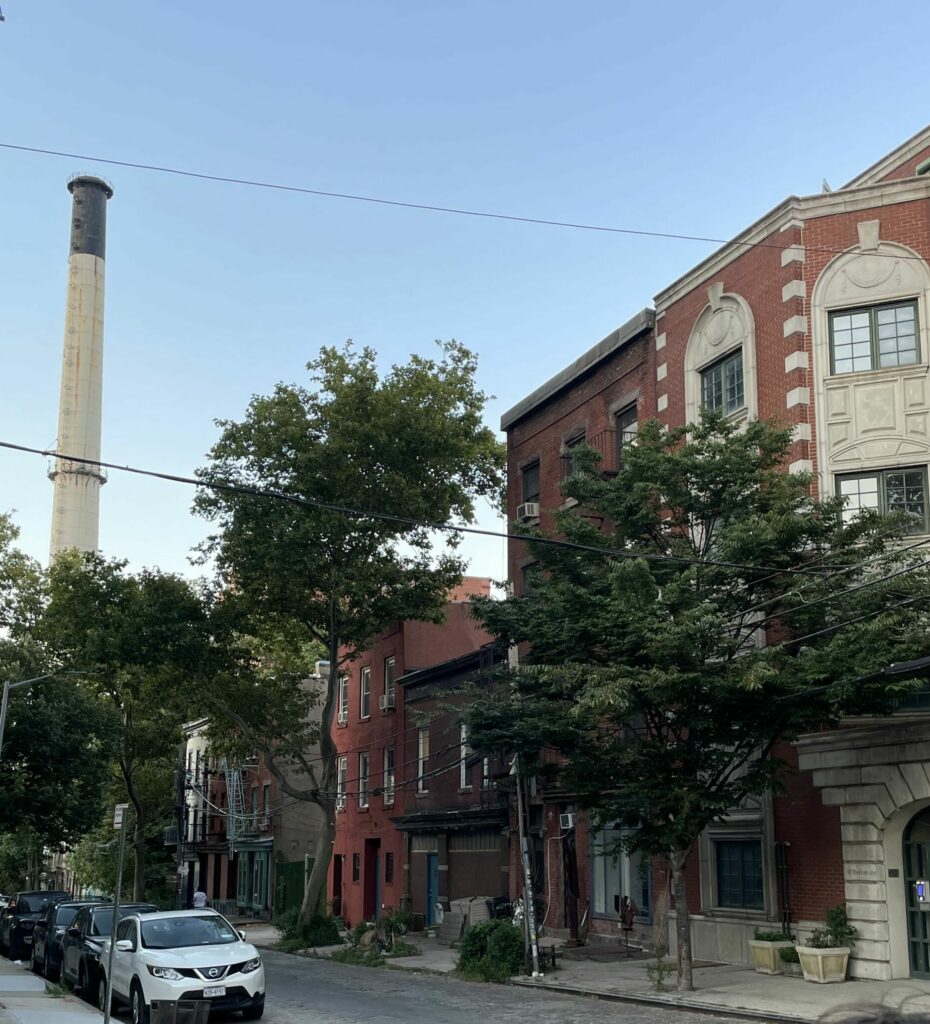
A view of Hudson Avenue in 2024, Brooklyn, NY. September 3, 2024. Photographed by Tim Morrissey on iPhone 14.

Source: New York State Census, 1855, Brooklyn City, Ward 5, E.D. 1, page 14, Chart by Gracelyn Barmore-Pooley, Fall 2024, New York University
[1] “Plate 3: Map bounded by East River, Brooklyn Navy Yard, York Street, Bridge Street,” Image ID 1268419. New York Public Library Digital Collections.
[2] Eneas J Cannon, Household 60, Families 261-164, King’s County (Brooklyn City), Ward 5, ED 1, p. 14. Ancestry.com. New York, State Census, 1855 [database on-line]. Provo, UT, USA: Ancestry.com Operations, Inc., 2010.
[3] Clemuel Coffin, Dwelling 61, Families 265-267, King’s County (Brooklyn City), Ward 5, ED 1, p. 14. Ancestry.com. New York, State Census, 1855 [database on-line]. Provo, UT, USA: Ancestry.com Operations, Inc., 2010.
[4] Lemuel Coffin, Hearne’s Brooklyn Directory for 1853–1854 (Brooklyn: Henry R. & William J. Hearne, 1853), p. 109. Google Books
[5] George Murphy, Dwelling 64 Family 287, King’s County (Brooklyn City), Ward 5, ED 1, p. 15. Ancestry.com. New York, State Census, 1855 [database on-line]. Provo, UT, USA: Ancestry.com Operations, Inc., 2010.
[6] Stephen J. Sullivan., A Social History of the Brooklyn Irish, 1850-1900 (PhD, Columbia University, 2013), Chapter 4,181.
[7] Ibid.,141.