By Gracelyn Barmore-Pooley, Glucksman Ireland House, New York University
© Gracelyn Barmore-Pooley, 2024. All rights reserved.
In the 1855 New York State Census, Eneas J. Cannon and his brother John are listed as booksellers. [1] He was a “vender” in the 1860 census but was dead by 1862 as a prisoner of war after enlisting in the 69th Infantry, Company B, also known as the Fighting Irish brigade of the Union Army. [2] Clearly, bookselling was a viable career option for Irish immigrants to Brooklyn, but one that did not necessarily promise longevity within the profession. Print culture was in some ways essential to immigrant life in America, but literacy was not common to every Irish emigrant living in Irishtown. But how common was the profession of bookselling or owning a bookstore, and what purpose did bookstores serve within the community?
In the 1853 Brooklyn City Directory, 29 men are listed as booksellers. An Edward James is described as a bookseller, residing at 46 Hudson Ave.[3] Eneas Cannon lived at 45 Hudson Ave in 1855, so perhaps the men were neighbors for a time, walking to work together, or James may have had a role in getting Eneas and John Cannon their jobs. There is no bookstore specifically noted in maps of Irishtown, meaning Cannon and James likely worked outside of their immediate neighborhood. In the 1855 New York State Census, an Edward James is listed at a different address, but still in Ward 5, as a printer.[4] He was originally from England, and had been in the country for five years, living in a frame dwelling worth $3,000 that was shared with only one other family. Since printer was a more skilled occupation than bookselling, the field may have provided a unique opportunity for advancement. Regardless, jobs associated with print culture could enable individuals to save money and accumulate assets. Eneas J. Cannon had $1.50 in his bank account at its closing equivalent to $57.30 in 2023 USD.The highest amount on deposit for Eneas Cannon’s household in 1856, however, was $243.50, equivalent to $9, 030.00 in 2023 USD.[6] Patrick Shanahan, another Irishman saving money with Emigrant, lived at 102 Bridge Street and worked as a book binder. The highest amount in his bank account was $337.75 in January 1858, and his end balance was $276.33 equivalent to $10,400.00 in 2023 USD.[7]

Advertisement, Hearne’s Brooklyn City Directory for 1853-1854, p. 14. HathiTrust.org
Two bookstores placed advertisements in the 1853 Brooklyn Directory. One, for “Goater & Ray Circulating Library” described the business as a booksellers and stationers, with a store located at 99 Myrtle Avenue.[8] The contents of the ad illuminate much of what bookstores provided to the community. Alongside selling books, it emphasized in large font that all the “Daily, Weeinckly, and Monthly PAPERS & MAGAZINES” were “constantly” on hand. Goater & Ray’s also sold schoolbooks, blank books, and law blanks, as well as writing supplies like “papers in endless variety, quills, steel pens, black, blue and red inks,” and so forth. They also offered engraving services, with “door plates, business, wedding and visiting stores” engraved “in the neatest style and at the lowest .”[9]
A list of all school books being used was provided in the Appendix of the City Directory, including a variety of readers and textbooks alongside blank books and “Copy Books, plain ruled.”[10] While access to textbooks may have been possible through the school itself, families could turn to bookstores like Goater & Ray for extra supplies. An “Ebeneza Ray” was listed in the 1855 Census in Brooklyn City, Ward 11, working as a “stationer.”[11] He was also English, and had lived in the area for two years, although he had a daughter aged six who was born in New York. Bookselling required literacy, as well as skill in handling money and retail. This may have privileged more educated immigrants from England as well as Ireland, and enabled the literate to access books, newspapers, magazines, and more.
Bookstores also functioned as community hubs, with tickets for various events often sold at multiple sites throughout the city. For example, tickets to the Franklin Debating Association’s second anniversary, hosted at the Brooklyn Institute, cost twelve-and-a-half cents each and were available for purchase at multiple bookstores including Wilder & Babcock at 51 Fulton, Smith’s under the Globe Hotel, Marsh’s at 175 Atlantic, as well as Goater & Ray’s at 99 Myrtle.[12] Residents may have frequented bookstores to see what events were happening, or followed newspaper advertisements there.
In another example, the Brooklyn Athenaeum sold tickets for a vocal and instrumental concert, the “greatest attraction of the season,” at bookstores including Marsh’s, which was located at the Athenaeum itself.[13] It promised to sell “all the magazines, new works, novels, music, stationery, fancy goods, pictures, [and] blank books,” at its location.[14]
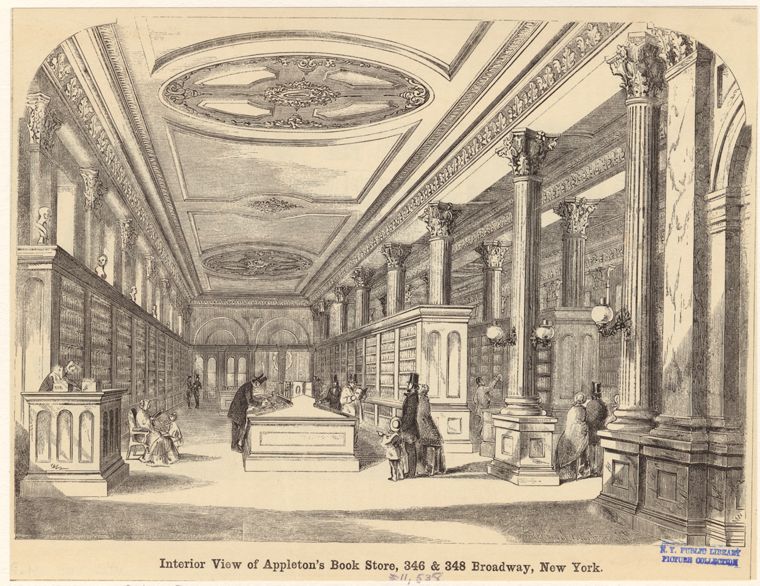
The interior view of Appleton’s Bookstore in 1856, which later relocated its printing plant to Brooklyn. New York Public Library Digital Collections, ID 809788.
Bookstores were not just “stores engaged in both wholesale and retail trade” during the nineteenth-century, but also “businesses that published books” while sometimes “[doubling] as a circulating library or reading room.”[15] By 1915, half of all the bookstores in Brooklyn were second-hand, indicating that literature and literary culture was accessible to many.[16] Many of the bookstores in the neighboring City of New York in the 1830s also dabbled in publishing, alongside the development of the larger publishers.[17] In fact, many of the publishing offices based in Manhattan moved their manufacturing operations to Brooklyn, potentially including a “printing plant, bindery, and shipping department.”[18] For example, Appleton’s, one of the largest and most successful bookstore and publishing house in Manhattan and a “landmark in New York City’s cultural landscape,” moved their printing plant to Williamsburgh in 1868.[19] The plant occupied “nearly an entire city block,” and employed 700 people by the 1880s, potentially including some Irish immigrants or their children who had dispersed from Irishtown throughout Brooklyn.[20] Although New York was “full of immigrant printers,” they were “higher on the socioeconomic ladder” than peddlers, but made less than other artisans in the building trades.[21] It was common for Irish immigrants printers to have previously trained or apprenticed in Ireland, enabling access to higher-paying jobs in the realm of print culture.[22]
Another bookstore to advertise in the 1853 Brooklyn City Directory was M. Nevin’s, described as a “CHEAP BOOK STORE” on 180 Fulton.[23] His advertisement emphasized the low prices of his wares, as well as the inclusion of “Landlords’ and Tenants’ Agreements” and “House Bills” among the items sold. It promised that M. Nevin’s would have “everything proper to be kept in a Book Store.”

An advertisement for Michael Nevin’s bookstore, located at 180 Fulton Street, published in Hearne’s Brooklyn City Directory for 1853-1854.
Advertisements for M. Nevin’s bookstore were common in the Brooklyn Eagle, with a near-identical advertisement to the Directory seen on the front page in December of 1846.[24] The location of M. Nevin’s storefront changes throughout the 1850s, but it was always on Fulton Street.
Michael Nevin, a native of Co. Wexford, was listed in the 1855 census as living in a brick house worth $7,000.[25] He had been in the country for twelve years, meaning his year of emigration was likely 1841 and had opened a savings account with Emigrant two years earlier.[26] His occupation was reported as “bookstore,” indicating that he was the owner or proprietor. He lived at 180 Fulton Street with his wife Catherine and their four sons, all under five and all born in King’s County. They also employed a servant, a Susanna Gariff age seventeen, who had emigrated from Ireland the previous month. Of the five brothers in the United States whom he reported to the Bank’s accountant, two are listed in the 1853 directory as working at a bookstore.[27] Nevin can be found in the 1860 Federal census, living in Ward 3, District 1, with his occupation listed as “Books & Stationery.” At this point, his real estate value and personal value were both listed at $6,000, indicating that he owned the house or bookstore.[28] He had had a daughter in the intervening years, and now employed Mary Farrell as his servant, who was also from Ireland. In the 1870 Federal Census, his occupation is listed as “stationer,” with his real estate value at $50,000 and his personal value at $10,000, clearly a rise in his financial fortunes.[29] By then, he employed a servant, a Mary Breen from Ireland, and may also have been letting a room to Robert Bogardus, a dentist. Nevin died on July 18, 1879, in his home on Vanderbilt Avenue, with a service to follow at St. John’s Chapel.[30]
It is clear from the staggering success of Michael Nevin that bookselling, or owning a bookstore, was one way to accumulate wealth and property for Irish immigrants, and that they provided both community and creativity to the broader Brooklyn community. Whether Eneas Cannon might have achieved such success was cut short by his death in the American Civil War.

One location of M. Nevin’s Bookstore, at 103 Fulton, with other locations higher up, from William Perris’ Maps of the City of Brooklyn, Plate 28, 1268444, New York Public Library Digital Collections.[31]
[2] Eneas Cannon, Household 9, King’s County (Brooklyn City), Ward 5, ED 21, p. 49. Ancestry.com. United States, Federal Census, 1860 [database on-line]. Provo, UT, USA: Ancestry.com Operations, Inc., 2010; Eneas E Carlmon, Ancestry.com. New York, U.S., Civil War Muster Roll Abstracts, 1861-1900 [database on-line]. Lehi, UT, USA: Ancestry.com Operations, Inc., 2011.
[3] Edward James, Hearne’s Brooklyn City Directory for 1853-1854 (Brooklyn: Henry R. & William J. Hearne, 1853), p. 274. Google Books.
[4] Edward James, King’s County (Brooklyn City), Ward 5, ED 2, p. 6. Ancestry.com. New York, State Census, 1855 [database on-line]. Provo, UT, USA: Ancestry.com Operations, Inc., 2010.
[5] EISB Acct. No. 9889, Eneas J. Cannon, Deposit Account Ledger, Ancestry.Com. New York, Emigrant Savings Bank Records, 1850-1883 [database on-line]. Provo, UT, USA: Ancestry.com Operations Inc, 2005.
[6] Tyler Anbinder, Cormac Ó Gráda, and Simone Wegge, “Emigrant Savings Bank Depositor Database, 1850-1858,” version 3.0, September 13, 2019, accessed via https://doi.org/10.7910/DVN/DDG8SW
[7] EISB Acct. No. 8623, Patrick Shanahan, Deposit Account Ledger, Ancestry.Com. New York, Emigrant Savings Bank Records, 1850-1883 [database on-line]. Provo, UT, USA: Ancestry.com Operations Inc, 2005.
[8] Advertisement for “Goater & Ray Circulating Library,” Hearne’s Brooklyn City Directory for 1853-1854 (Brooklyn: Henry R. & William J. Hearne, 1853), p. 14. Google Books.
[9] Ibid.
[10] Appendix – Board of Education, Hearne’s Brooklyn City Directory for 1853-1854 (Brooklyn: Henry R. & William J. Hearne, 1853), p. 27. Google Books.
[11] Ebeneza Ray, King’s County (Brooklyn City), Ward 11, ED 2, p. 1. Ancestry.com. New York, State Census, 1855 [database on-line]. Provo, UT, USA: Ancestry.com Operations, Inc., 2010.
[12] Advertisement for the “Franklin Debating Association,” Brooklyn Eagle (Brooklyn, New York), February 27, 1854, p. 1. Brooklyn Newsstand at Brooklyn Public Library.
[13] Advertisement for the Athenaeum, “Greatest Attraction of the Season,” Brooklyn Eagle (Brooklyn, New York), May 26th, 1855, p. 2. Brooklyn Newsstand at the Brooklyn Public Library.
[14] Advertisement for “A.M. Wilder,” Brooklyn Eagle (Brooklyn, New York), August 17, 1854, p. 2. Brooklyn Newsstand at the Brooklyn Public Library.
[15] Kristen Doyle Highland. “In the Bookstore: The Houses of Appleton and Book Cultures in Antebellum New York City.” Book History 19 (2016), 215.
[16] Edwin D. Hoffman. “The Bookshops of New York City, 1743-1948.” New York History 30, no. 1 (1949), 62.
[17] Hoffman, 58
[18] Joshua Brown and Ment, David. Factories, Foundries, and Refineries: A History of Five Brooklyn Industries. (Brooklyn: Brooklyn Rediscovery, Brooklyn Educational & Cultural Alliance, 1980), 32.
[19] Highland, 242; Brown and Ment, 33.
[20] Brown and Ment, 34; Stephen J. Sullivan., A Social History of the Brooklyn Irish, 1850-1900 (PhD, Columbia University, 2013), Chapter 4, 122.
[21] Tyler Anbinder, Plentiful Country: The Great Potato Famine and the Making of Irish New York (Boston: Little, Brown, 2024),157-158.
[22] Anbinder, 156.
[23] Advertisement for “Brooklyn Cheap Book Store,” Hearne’s Brooklyn City Directory for 1853-1854 (Brooklyn: Henry R. & William J. Hearne, 1853), p. 13. Google Books.
[24] Advertisement for “Brooklyn Cheap Book Store,” Brooklyn Eagle (Brooklyn, New York), December 16th, 1846, p. 1. Brooklyn Newsstand at Brooklyn Public Library
[25] Michael Nevin, King’s County (Brooklyn City), Ward 3, ED 1, p. 44. Ancestry.com. New York, State Census, 1855 [database on-line]. Provo, UT, USA: Ancestry.com Operations, Inc., 2010.
[26] EISB Acct. No. 3472, Michael Nevin, Test Book, Ancestry.com. New York, Emigrant Savings Bank Records, 1850-1883 [database on-line]. Provo, UT, USA: Ancestry.com Operations Inc, 2005. Unfortunately, multiple parts of the entry are smeared/illegible.
[27] Michael Nevin, Hearne’s Brooklyn City Directory for 1853-1854 (Brooklyn: Henry R. & William J. Hearne, 1853), p. 402. Google Books.
[28] Michael Nevin, King’s County (Brooklyn City), Ward 3, ED 1, p. 131. Ancestry.com. United States, Federal Census, 1860 [database on-line]. Provo, UT, USA: Ancestry.com Operations, Inc., 2010
[29] Michael Nevin, Household 436, King’s County (Brooklyn City), Ward 3, p. 80. Ancestry.com. United States, Federal Census, 1870 [database on-line]. Provo, UT, USA: Ancestry.com. Operations Inc., 2010
[30] Obituaries, “Died—Nevin,” The Brooklyn Eagle (Brooklyn, New York), July 21, 1879, p. 3. Brooklyn Newsstand at Brooklyn Public Libraries.
[31] “Plate 28: Map bounded by Willoughby Street, Gold Street, Fulton Avenue, Bond Street, Schermerhorn Street, Hoyt Street, Jay Street,” Image ID 1268444. New York Public Library Digital Collections.