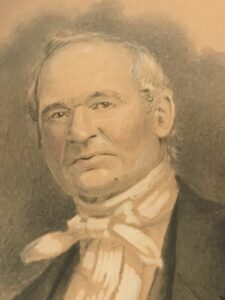
John G. Murphy, prominent Brooklyn
businessman and owner of the New York and Brooklyn Crown Glass Works. SOURCE: Bambi, www.findagrave.com, Memorial ID: 124912518
By Tim Morrissey
©Tim Morrissey, 2024. All rights reserved.
John Garrison Murphy and Henry Cruse Murphy, father and son, were two prominent Brooklyn residents who were second and third generation Irish Americans. John’s father, Timothy Murphy, emigrated from Ireland in 1769 and served in the Continental Army during the American Revolution, before settling in Middletown, New Jersey.[1]
John Murphy moved to Brooklyn where he became a prominent businessman and inventor, patenting a model wheel integral to the proliferation of the steamship along New York waterways. Murphy was also the owner of the New York and Brooklyn Crown Glass company when it burnt down in 1848, and afterwards entered into a partnership with Samuel Engle to refurbish the factory to sell “green glass.”[2] It is very likely that this is the “Empire Flint Glass Company” listed on the Brooklyn Fire insurance map in 1855, although this company does not appear anywhere in the newspaper records of the Brooklyn Eagle or on the federal non-population schedules of the census.
John G. Murphy passed away in February of 1853 at the age of 70 from “congestion of the brain.”[3] It appears he died in the middle of a lawsuit against him and Engle by Martha Demarest, for which his wife Caroline Murphy (along with a “James Engle”), was forced to sell a large amount of his land in Brooklyn’s Fourth Ward. The 1853 Directory gives the address as 17 Concord Street.[4] In 1857, his heirs put much of the land up for sale, including “3 lots and buildings” on Marshall Street between Hudson Ave and Gold St,[5] likely the remains of his glass works, labeled on maps as the “Atlantic White Lead Company” in 1861.
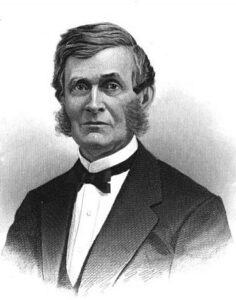
Henry C. Murphy, prominent Brooklyn Politician who served in the United States House of Representatives, and was integral to the foundation of the Brooklyn Public Library, the Brooklyn Eagle, and the construction of the Brooklyn Bridge. SOURCE: “Memoir of Hon. Henry C. Murphy, LL.D., of Brooklyn, N.Y.”. 1883. Frontispiece.
Though his stint in the glass industry was not long lived, John G. Murphy’s fortune nonetheless set the groundwork for his even more prominent son, Henry C. Murphy, who became “one of Brooklyn’s most conspicuous citizens.”[6] Henry Murphy was mayor of Brooklyn from 1842-1843, beat out Whig candidate Benjamin D. Silliman in 1842 for a seat in the United States House of Representatives where he served from 1843-1845,[7] secured the Navy Dry dock for Wallabout bay which largely employed Donegal immigrants, was the founder of the Long Island Historical Society and the Brooklyn City Library.[8] He was later active in the construction of the Brooklyn Bridge, and was also one of the founders and first editors of The Brooklyn Daily Eagle.[9]
Under Murphy’s editorship, The Eagle began soliciting donations for Irish Famine relief in February of 1847 with the headline, “Give Now. Wait Not. Pestilence and ashy-faced starvation have their grip on hundreds of thousands of our fellow creatures.” By April, it was publishing nativist complaints about new Irish immigrants. Murphy headed a “committee of thirteen” to organize a Brooklyn Irish Relief Committee, meeting at Hall’s Exchange and the Brooklyn Institute. The Committee, along with its partner the Ladies’ Irish Relief Committee, raised money and donated seeds throughout the course of the Famine. Workers at the Brooklyn Navy Yard managed to cobble together $650 and 120 Barrels of Meal to donate to Irish famine relief. Henry C. Murphy was a friend of and in correspondence with Irish immigrant Edmund Bailey O’Callaghan, who was the first Secretary Archivist of the State of New York. O’Callaghan had previously escaped to the United States from Canada because of his involvement in the Lower Canada Rebellion.[10] Both Murphys were buried in Green-wood cemetery, and were Methodists.
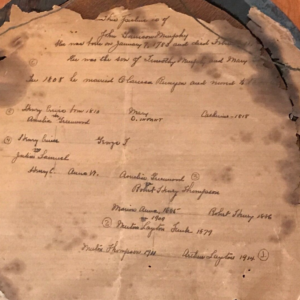
The Murphy Family tree, written onto the back of the charcoal drawing of John G. Murphy. SOURCE: Bambi, findagrave.com, Memorial ID: 124912518
[1] Samuel W. Green. A Complete History of the New York and Brooklyn Bridge, 1883, p. 87. New York: S. W. Green’s Son. ISBN 978-0608421490.
[2] “Notice of business”, Brooklyn Eagle, May 8th, 1851, p. 4.
[3] Religious Notices, Brooklyn Eagle, February 12th, 1853, p. 3. https://bklyn.newspapers.com/image/50247165/?match=1&terms=john%20g.%20murphy
[4] “Murphy, Caroline, widow of John G., 17 Concord” p. 364
[5]Corporation Notice, Brooklyn Eagle, May 21st, 1857, p. 3. https://bklyn.newspapers.com/image/50398535/?match=1&terms=john%20g.%20murphy
[6]Dead. One of Brooklyn’s Most Conspicuous Citizens. Brooklyn Eagle, December 1, 1882. p. 4.
[7] A Biographical Congressional Directory, 1774 to 1903, p. 711 https://archive.org/details/abiographicalco00enyagoog/page/718/mode/2up
[8] “Henry Cruse Murphy” in James Grant Wilson and John Fiske (eds.), Appletons’ Cyclopaedia of American Biography: Volume 4. New York: D. Appleton & Co., 1888; pp. 465–466.
[9] Suzanne Spellen, “Walkabout: The Lords of Owl’s Head, Part 1.” Brownstoner, July 21, 2016. https://www.brownstoner.com/history/walkabout-the-lords-of-owl%E2%80%99s-head-part-1/.
[10] “Biography – O’CALLAGHAN, EDMUND BAILEY – Volume X (1871-1880)”. www.biographi.ca. Dictionary of Canadian Biography.