The Cone of the glassworks of Irishtown. At the time this birds eye view map was drawn, the factory was managed by the Empire Flint Glass Company. Detail from “City of Brooklyn, L.I. Taken from Rush Street” (1855), New York Public Library Digital Collections ID 1659387.
by Tim Morrissey, Glucksman Ireland House, New York University
©Tim Morrissey, 2024. All rights reserved.
Glass production was a foundational industry to the rapid growth of the City of Brooklyn in the nineteenth century as a critical player within global trade. Brooklyn’s economy and population grew simultaneously with a shift in taste from Crown to Flint glass, bolstered by technological innovations such as steam-powered glass cutters and the Donaldson furnace, which allowed for a clearer product and used far less fuel.[1] An economic depression in the aftermath of the Napoleonic Wars and resultant excise taxes on Irish glass by the English government post Act of Union resulted in a severe decline in glass production at once dominant Irish, Scottish, and English glassworks, including Waterford (1783-1851).[2] “Having no work in Dublin, and with no vacancies at other Irish glasshouses, many glassblowers, cutters, and engravers moved to America where a number of glasshouses had been recently established.”[3]
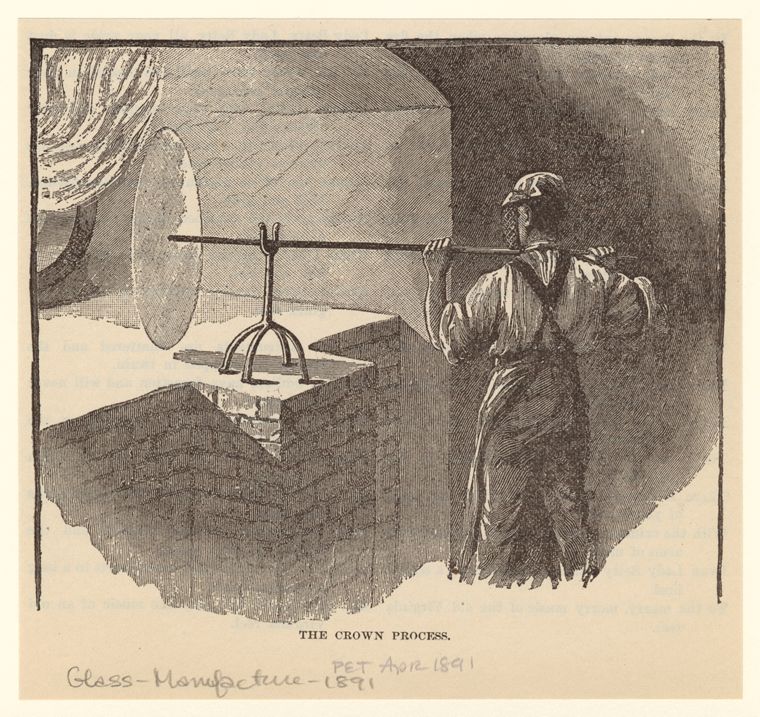
The Crown Process involved spinning a circle of glass at the end of a rod. This would result in a large flat and circular piece of glass from which smaller squares could be cut, but would also leave a characteristic “bullseye,” that was deemed undesirable, until an artistic revival in the late 19th century made it fashionable again. Credit: The New York Public Library. “The crown process” New York Public Library Digital Collections. Accessed November 26, 2024. https://digitalcollections.nypl.org/items/510d47e1-373b-a3d9-e040-e00a18064a99
Crown glass, a simpler technique for glass production, requires minimal blowing, instead using a spinning method to extend a circular plate of glass with centrifugal force, and resulted in high quality “table” of glass from which smaller sections could be cut.[4] An 1827 advertisement for the prices of Crown glass manufactured at the New England Crown Glass company of Boston states that theirs was “the only Crown Glass manufactured in the United States.”[5]
Soon, after “a construction accident on the site of ‘a large brick building, of circular form…on the margin of the East River, near Jackson Street Ferry’”,[6] the New York and Brooklyn Crown Glass Company opened its doors in 1833. The company won “second best specimen” for window glass at the 1835 Fair of the American Institute[7] and appears near the Brooklyn Navy Yard on an 1838 land sale map.[8]

Four stages in Crown Glass production. The glass is blown into a pear shape, flattened, reheated, and then spun. CREDIT: William Cooper, Crown Glass Cutter and Glazier’s Manual (Edinburgh: Oliver & Boyd, 1835), p. 30-33.
Located on twelve lots between Marshall and John streets, and between Gold and Jackson Street (Hudson Ave), the New York and Brooklyn Crown Glass Company produced glass through the crown method up until it burnt down. On an April morning in 1848, a fire broke out “in the large brick cone [and] the varnish took fire which in an instant communicated to the wood work of the building which were entirely destroyed.”[9] Amongst the nearby buildings destroyed by the Glass Works fire were J. Haskins’ malt house, the glass manufactory of Murphy and Clark, the pipe works of J.A. Smith and the gold refinery of John R. Longman. The fire was contained by the local firemen from the station on Jackson Street(Hudson Ave).
The lots were owned by John G. Murphy Esq. “and several others of the old glass company.” In August of 1848, they were put up for sale:
Six lots on John Street, near Hudson Avenue (late Jackson st.). Six lots on Marshall Street in rear of the above. These lots are occupied by Mr. Longman gold refiner, by the large cone of the glass works, and two brick houses. Also between six and seven lots of ground between Marshall Street and the bulk head, adjoining Shirwell’s white lead works, 63 feet adjoining the water, and covered with light buildings.
Inquiries into purchasing the land were handled by John Dikeman Esq. and Alden Spooner of 57 Fulton Street.[10]
This was, however, followed by a much larger fire called “The Great Conflagration” in September of 1848, which burnt down four uninsured brick buildings also owned by Murphy.[11] A Brooklyn businessman and a second-generation Irish American, Murphy then opened a green glass factory with Samuel Engle.[12] He died in 1853, and by 1855, the Empire Flint Glass Works occupied the location of the Old Crown Glass Factory.
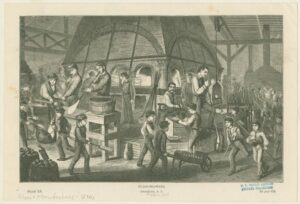
Glass Blowing in Brooklyn, New York, c. 1870. Many of the workers at glass works in Brooklyn were young boys. The central “cone” of the glassworks was the location of a large fire into which globs of molten glass could be plunged for heating. Once heated, this glass could be molded, as shown in the right side of this image, where a laborer blows into a pipe to shape glass in a mold held by a young boy. The final result were mass produced glass bottles, lined up in the cart at the center of the image. Credit: The New York Public Library. “Glass-blowing, Brooklyn, N.Y.” New York Public Library Digital Collections. Accessed November 26, 2024. https://digitalcollections.nypl.org/items/510d47e3-b986-a3d9-e040-e00a18064a99
Flint glass, often called “Flint and Sand” glass, is a dense and durable leaded glass, invented by George Ravenscroft in 1675.[13] It requires the addition of lead oxide, calcium carbonate, called “whiting,” and potash to achieve its high level of clarity. Production of flint glass was brought to Brooklyn by John Gilliland in 1823, right as once dominant Irish, Scottish, and English flint glass faced economic crisis and increased debt from the unsold products.[14] Gilliland’s “Brooklyn Flint Glass Company” took advantage of this economic downturn, along with innovations in glassmaking to establish Brooklyn as an industrial base for glass production. In 1852, Christian Dorflinger founded his first flint glass factory in Brooklyn, followed by the larger Long Island Flint Glass Works on Plymouth Street a year later, in proximity to Irishtown. As his business grew, he founded a much larger factory in Greenpoint, Brooklyn in 1860.[15] The separate factories of Gilliland and Dorflinger challenged quality glass manufacturing in the United States and the Atlantic World at large.[16]
Glass cutting, the adornment of glass after it was blown and molded, was performed by skilled glass cutters or through industrial steam engine cutters, the success of the flint glass industry made Brooklyn “a mecca for glass cutters.” Demand for lead crystal, high quality cut glass for upper class customers – including for Mary Todd Lincoln’s White House[17] – resulted in transatlantic communication between newer crystal manufacturers of Brooklyn and older manufacturers in Ireland and England. Nevertheless, as an 1851 account in the Brooklyn Eagle stated, Brooklyn glass was often referred to as “an American article” and struggled to find overseas sales due to “deep and vulgar prejudice” against American manufacturing, likely because the American flint glass manufacturing process was “much cheaper” than European manufacturing while also replacing domestic demand for glassware that had previously bought from Ireland and England. Popular items for upper class customers were decanters and cordials.
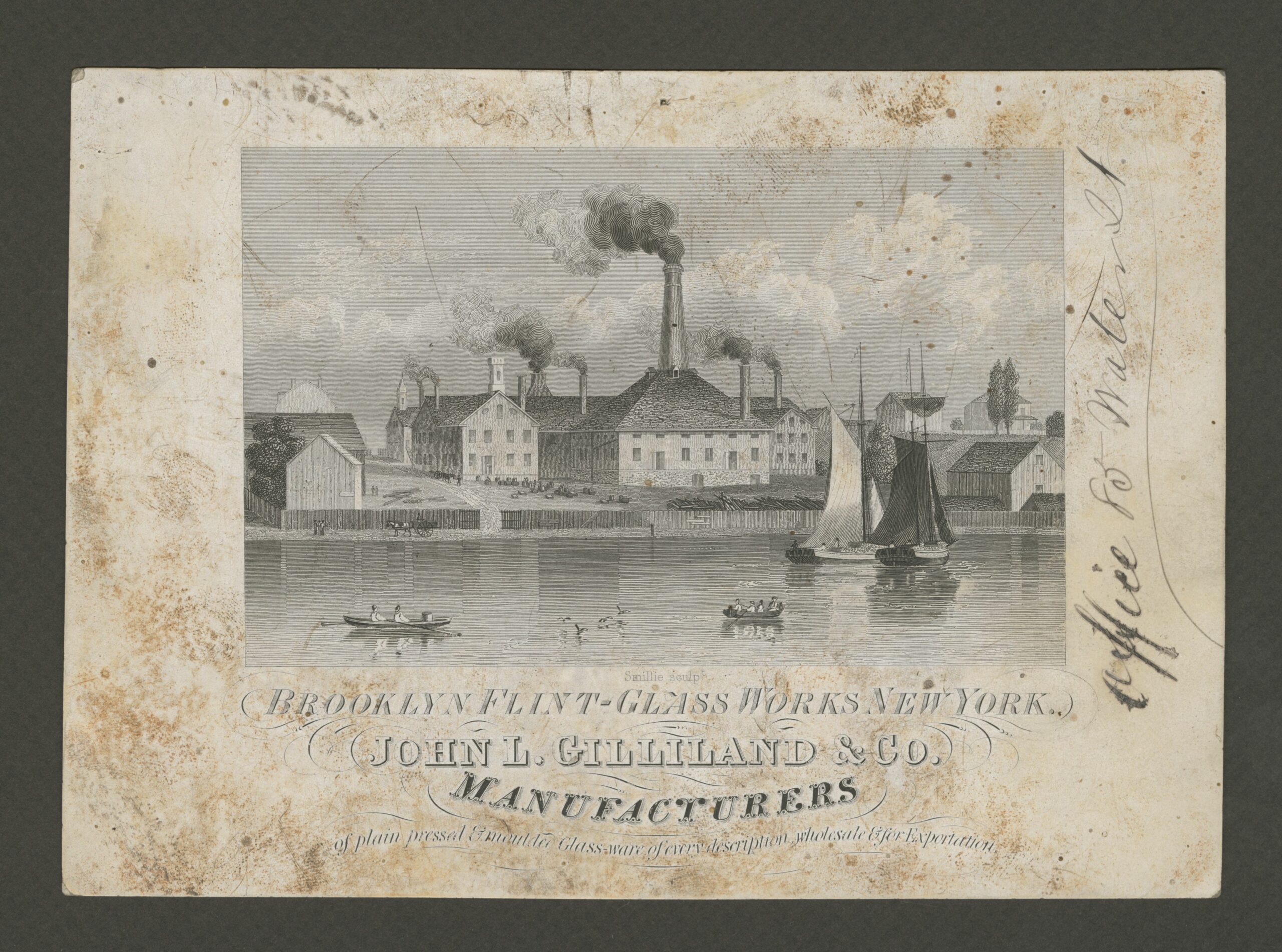
The Brooklyn Flint Glass Works in Brooklyn Heights from the East River Waterfront. CREDIT: Smillie, James. Brooklyn Flint-Glass Works New York : John L. Gilliland & Co. 1852.
This 1851 account of the Brooklyn Flint Glass Works likewise gives a rather detailed accounting of what glass works entailed. “The principal materials used in the manufacture of flint glass are silex, red oxide of lead, and potash; there are few other ingredients used in small quantities, principally for purifying and bleaching. It is believed that nearly the entire product of American Pearl Ash is used by the flint glass manufacturers of this county. In these works are employed one hundred and thirty operatives, who can earn from $1.75 to $15 per week and the annual amount paid for labor is $50,000.”[18]
In 1855, eighty-four Irish-born men made up 59% of all the glassworkers in New York County.[19] Some of these may have taken advantage of the easy access to glassworks in Brooklyn via the Jackson Street Ferry. By 1860, the Brooklyn Flint Glass Company employed 135 men who earned approximately $32 a month, as well as 9 women who earned far less ($11 per month). The business was valued at $100,000. Of the 22 men living in Irishtown who gave their occupation as “laborer” to Emigrant Savings Bank’s accountant, some – like John Gregan and Bernard Bohan, who lived at 34 Hudson Avenue,[20] may have worked for this large neighborhood employer. Within Irishtown, William Lynch (corner of John Street and Pearl Street), John Mullen (32 Hudson Avenue), John MacMullen (36 Hudson Aveneue), Thomas MacMullen (John Street and Hudson Avenue) are all listed in the 1853 Brooklyn directory as glass blowers.[21]
[1] John M. Hearne, “Irish Enterprise, English Alchemy and the Creation of a Brand: The Waterford Glassworks, 1783-1823” in John M. Hearne, ed. Glassmaking in Ireland : From Medieval Times to the Contemporary (Dublin: Irish Academic Press, 2010), p. 160.
[2] “Heritage,” Waterford. Accessed Dec. 5, 2024. https://www.waterford.com/en-gb/discover-waterford/the-waterford-story/heritage
[3] Anna Moran, “Technology and Innovation: Interpreting a Sketch of the Waterford Glasshouse Drawn in 1823 by the Architect C. R. Cockerell,” in Hearne, ed. Glassmaking in Ireland, p. 179.
[4] Britannica, The Editors of Encyclopaedia. “crown glass”. Encyclopedia Britannica, 25 Nov. 2011, https://www.britannica.com/technology/crown-glass. Accessed 5 December 2024.
[5] William Parmenter, Prices Current of Crown Window Glass, Manufactured by the New-England Crown Glass Company–Boston (Boston: True and Greene, printers, 1827). Ephemera Collection, Historic New England. Accessed Dec. 5, 2024. https://gusn.us/316491
[6] Maynard E. Steiner, “Early Glassmaking at the Brooklyn Works,” Acorn, Vol. 5. 1994 (Sandwich, Mass: Sandwich Historical Society), p. 48.
[7] Maynard E. Steiner, “Early Glassmaking at the Brooklyn Works,” Acorn, Vol. 5. 1994 (Sandwich, Mass: Sandwich Historical Society), p. 60.
[8] “Peremptory sale of valuable property in the city of Brooklyn near the Navy Yard belonging to the estate of John Jackson, decd., by Jas. Bleecker & Sons on Thursday, 25th Octr., 1838, at 12 o’clock at their sales room, 13 Broad St,” Map No. B P-[1838]a.Fl. Map Collections, Center for Brooklyn History. Accessed Dec. 5, 2024.https://mapcollections.brooklynhistory.org/
[9] “Destructive Fire”, Brooklyn Evening Star (New York), April 7, 1848, p. 2.
[10] “Valuable Property for Sale,” Brooklyn Evening Star (New York), August 26, 1848, p. 3.
[11] “The Great Conflagration!” Brooklyn Evening Star (New York), September 11, 1848, p. 2.
[12] “Notice of business”, Brooklyn Eagle (New York), May 8, 1851, p. 4.
[13] Britannica, The Editors of Encyclopaedia. “flint glass”. Encyclopedia Britannica, 13 Sep. 2022, https://www.britannica.com/technology/flint-glass. Accessed 5 December 2024.
[14] Hearne, ed. Glassmaking in Ireland, p. 161-162.
[15] John Cummings, “The Dorflinger Glass Works,” New York History 34, no. 4 (1953): 468–74.
[16] “Q. Was the Brooklyn Flint Glass Company an Ancestor of Corning Incorporated?” Corning Museum of Glass, Rakow Research Library: Ask a Glass Question. Accessed November 12, 2024. https://libanswers.cmog.org/faq/143884.
[17] Artifact and Artifact Record, Object ID M1988.54.2.| Center for Brooklyn History, Accessed Dec, 5, 2024. https://brooklynhistory.pastperfectonline.com/webobject/03BEF66B-E4F6-4A84-83BD-306056231000.
[18] “Brooklyn Flint Glass Works,” Brooklyn Evening Star (New York), May 28, 1851, p. 2.
[19] Table 27 “Occupations of Gainfully Employed Immigrants, by Nationality, 1855” in Robert Ernst, Immigrant Life in New York City, 1825-1863 (New York: Syracuse University Press, 1994), p. 214.
[20] EISB Account No. 3425, John Gregan and EISB Account No. 11797 Bernard Bohan, Test Books, Ancestry.com. New York, Emigrant Savings Bank Records, 1850-1883 [database on-line]. Provo, UT, USA: Ancestry.com Operations Inc, 2005.
[21] Hearne’s Brooklyn City Directory for 1853-1854 (Brooklyn: Henry R. & William J. Hearne, 1853), p. 325, 361, 397.