by Maeve Carey-Kozlark, Glucksman Ireland House, New York University
© Maeve Carey-Kozlark 2024. All rights reserved.
Ann Smith opened her first account with Emigrant Savings Bank in 1854, ten years after her June 1844 arrival in New York via Liverpool. The bank’s accountant recorded her as a native of Glasmullagh, County Monaghan, Ireland; one of 54 townlands within Anketell Grove, a (then) nearly eight-thousand acre estate situated across Errigal Trough and Donagh Parishes in Trough Barony, Monaghan, near the border with present-day Northern Ireland. [1]
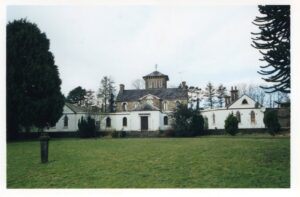
Anketell Grove Estate (built 1775), Co. Monaghan, pictured here in 2012. Via National Built Heritage Service, reg. no 41400610
Also included in the record are the names of her husband, Thomas Smith, and a father, John Cunningham, remaining in Ireland. Ann had no children at the time of account opening, and her occupation was listed as simply “domestic;” one year later, the 1855 New York State Census lists the pair as living in the nearby 6th Ward, or present-day Cobble Hill and Carroll Gardens, Brooklyn, with her husband employed as a coal worker.[2] Given the ten years between her arrival in the United States and her opening of the account, coupled with the prevalence of her and her spouse (Thomas Smith)’s names and lack of children, it is difficult to discern whether Ann arrived in the United States alone or married back in Ireland. Database searches for her maiden name, Cunningham, yielded similarly inconclusive results save for one Griffith’s Valuation survey from 1860 that shows no Smiths, but a single John Cunningham, as actively leasing 30 acres at Drumbanagher, Donagh Parish, from Anketell rent collector Charles Leslie.[3] While not definitively so, this could be the same John Cunningham listed as Ann Smith’s father in her Emigrant Savings bank entry. Per the Armagh Wills Calendar archives, Cunningham passed four years later in Mullinagore, Co. Monaghan, just south of Anketell Grove, with less than £50 to his name and no surviving immediate family members in Ireland.[4]
The parish Anketell Grove was situated in is described by Samuel Lewis as containing a “small amount of pasture…considerable tract of bog, and some woodland” with “much improved” agriculture and “excellent quarries of marble…and freestone.”[5] An inquiry on the “Condition of the Poorer Classes in Ireland” from 1860 includes a report from Robert Anketell that includes references to the land containing a “considerable portion of mountain and bog,” the “potato crop…not sufficiently ruminating,” and a “great many” having emigrated to America.[6] Thomas Anketell includes in the same report that the land was largely bog and roughly “one-fifth waste” and “around 50, in general of the poorer class,” tended to emigrate each year. Based on these accounts and the immigration (for those who left) and will (for those who remained in Ireland) records of other tenants at Anketell Grove, it seems that the land was not particularly conducive to farming, much less upward social mobility, on any major scale; among the most commonly listed occupations were stonemasonry, corn milling, or working onsite at the manor home as gardeners or in-home staff.
Records concerning the Anketell Grove estate predating 1850 are limited, so it is unclear when Ann and the Smith and/or Cunningham families began their tenancy on the land. Glasmullagh’s only mention in Griffith’s Valuation appears in 1860, where sixteen residents from families Wright, Hackett, Burn, Mills, McKenna, McCarn, Martin, Hall, Trainor, and Gunn are listed as leasing from a Thomas C. Singleton, great-grandson of Oliver Anketell III, who was himself a descendent of the Oliver Anketell who founded the estate in the late 17th century.[7] The Anketell family employed a few dozen rent collectors to manage the tenancies of different townlands within their estate, and in the 1840s began selling off portions of their land to said rent collectors or external private buyers, often resulting in automatic evictions or forced displacement as rents were increased beyond the means of the existing tenancy. This may have been a factor in Ann’s choice to leave for the United States in 1844.[8]
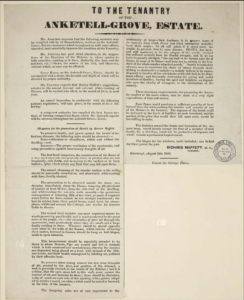
Letter to Tenantry of Anketell Grove, 1843. Via National Library of Ireland, record no. EPH E742
Another potential influence may be discerned from a public notice distributed to Anketell’s tenantry just one year earlier in 1843, which references the rapid spread of disease among households. The notice outlines a series of steps and cleanliness standards that tenants––at their own expense––were required to take to mitigate these risks, including leveling floors, adding walls, installing ventilation and/or seeing to specific window positioning, and keeping all animals, manure, and standing water outside a 50-foot radius of the home.[9] Failure to do so would put tenants at risk of eviction.
In 1836, the population of Errigal Truagh and Donagh was just shy of 20,000. By 1850, this number had fallen to around 6,000.[10] Father Patrick Moynagh, Parish Priest of Donagh between 1815 and 1860, is often credited with facilitating the emigration of hundreds to thousands from the two parishes immediately preceding and up through the early years of the famine.[11] While most of this emigration was directed at Prince Edward Island and other parts of Atlantic Canada––where Moynagh himself purchased hundreds of acres of agricultural lots in the island to provide homesteads and communities for families to settle into, and whose place names now reflect these origins: Treaugh, Kelly’s Cross––Father Moynagh also personally paid for the passage of single individuals to cities such as New York and Boston. As communities began to take root, emigration acquired its own momentum through family and personal connections; by 1850 more than 4,000 families had left and avoided the worst of the famine’s devastation thanks to Father Moynagh, either directly or by extension.[12] It is thus entirely possible that this sponsorship scheme, or the chain migration that ensued, might also explain and/or have facilitated Ann Smith/Cunningham’s emigration in 1844––and the high rates of emigration from Monaghan visible in the Emigrant Savings Bank data sample more broadly.
[1] Co. Monaghan → Trough → Errigal Trough Civil Parish → Anketell Grove Electoral Division → Glasmullagh, via https://www.townlands.ie/monaghan/trough/errigal-trough/anketell-grove/glasmullagh/
[2] New York, U.S., State Census, 1855: Kings, Brooklyn City, Ward 5, Edition 1. Entries for Thomas and Ann Smith (pg. 34, right, lines 8-9), via https://www.ancestrylibrary.com/imageviewer/collections/7181/images/005207201_00404?treeid=&personid=&queryId=ccd24050-3c7c-4bac-bdd7-e2e4c2c7dbb4&usePUB=true&_phsrc=Xwj1023&_phstart=successSource&pId=1654518748
[3] Askaboutireland.ie Griffith’s Valuation Record Information, “John Cunningham,” Glasmullagh, Anketell Grove, Monaghan. https://griffiths.askaboutireland.ie/gv4/z/zoomifyDynamicViewer.php?file=231052&path=./pix/231/&rs=9&showpage=1&mysession=2940711379040&width=&height=
[4] “The Will of John Cunningham late of Mullinagore in the County of Tyrone,” Public Record Office of Northern Ireland, Armagh Will Calendars, 1864. Via https://apps.proni.gov.uk/WillsCalendar_IE/willsSearchResultsDetails.aspx
[5] Lewis, Samuel. “DONAGH: A Parish,” in A Topographical Dictionary of Ireland, 1837. Via https://www.libraryireland.com/topog/D/Donagh-Trough-Monaghan.php
[6] Parliament of the United Kingdom, “Condition of the poorer classes in Ireland : appendix F: landlord and tenant, etc.” (1836) Via Virtual Record Treasury of Ireland, Enhanced Parliamentary Papers Collection, no. EPPI 1245311 – https://virtualtreasury.ie/item/EPPI-1245311
[7] Askaboutireland.ie Griffith’s Valuation Record Information, “Thomas C. Singleton,” Anketell Grove, Monaghan. Via https://griffiths.askaboutireland.ie/gv4/z/zoomifyDynamicViewer.php?file=231057&path=./pix/231/&rs=16&showpage=1&mysession=2940740003276&width=&height= ; Find a Grave, “Capt. Anketell Singleton, d. 21 Feb 1804.” Via https://www.findagrave.com/memorial/61561072/anketell-singleton
[8] National Built Heritage Service, “Anketell Grove, GORTMONEY, MONAGHAN,” Reg no. 41400610; Via https://www.buildingsofireland.ie/buildings-search/building/41400610/anketell-grove-gortmoney-monaghan
[9] Maffett, Richard and Surgeon, M.D. “To the tenantry of the Anketell-Grove, estate,” August 24, 1843. Via National Library of Ireland, Collection of Ephemera, no. EPH E742 – https://catalogue.nli.ie/Record/vtls000543950
[10] Diocese of Clogher, “Errigal Truagh Parish,” via https://www.truaghparish.com/history#:~:text=A%20Brief%20History,there%20is%20a%20holy%20well.
[11] McCluskey, Seamus. “Monaghan Heritage: Moynagh Initiated the PEI Connection,” The Northern Standard, September 10, 2008. Via https://archive-irishnewsarchive-com.proxy.library.nyu.edu/olive/APA/INA.Edu/SharedView.Article.aspx?href=NST%2F2008%2F10%2F09&id=Ar02600&sk=F2D67EBA&viewMode=image
[12] See footnote 10.