By Sandra O’Connor Carey, Glucksman Ireland House, New York University.
© Sandra O’Connor Carey, 2024. All rights Reserved.
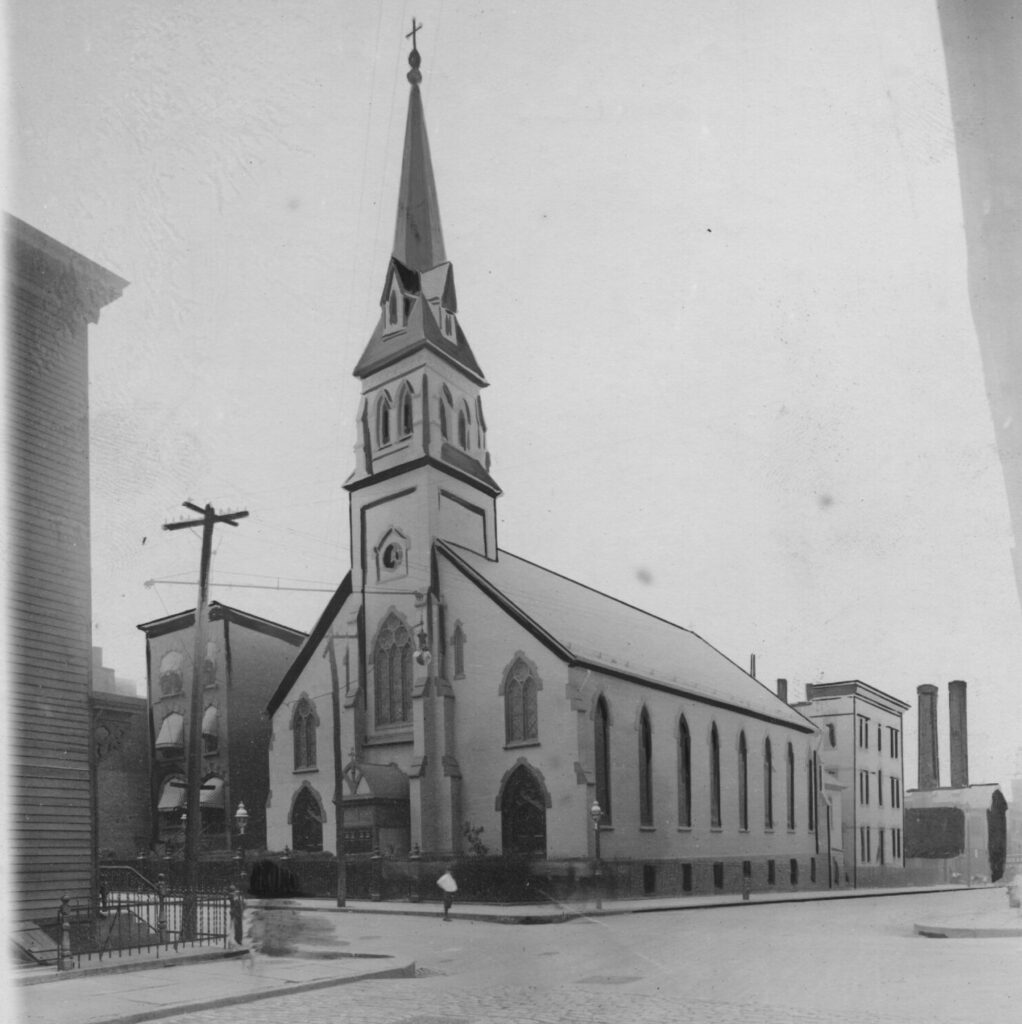
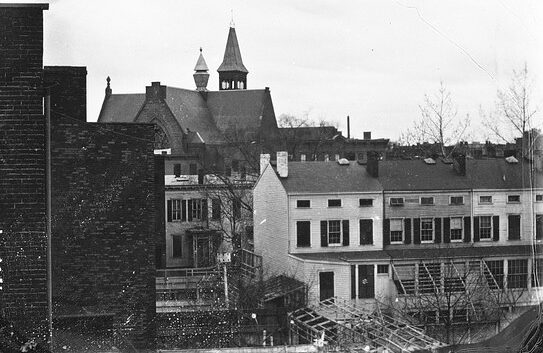
rectory, the church, and the parochial school (facing Gold Street.) CHUR_1323, Brooklyn Daily Eagle photographs, Brooklyn Public Library, Center for Brooklyn History. https://www.bklynlibrary.org/digitalcollections/item/721c2fe2-2057-406a-9d36-b8b492c127aa
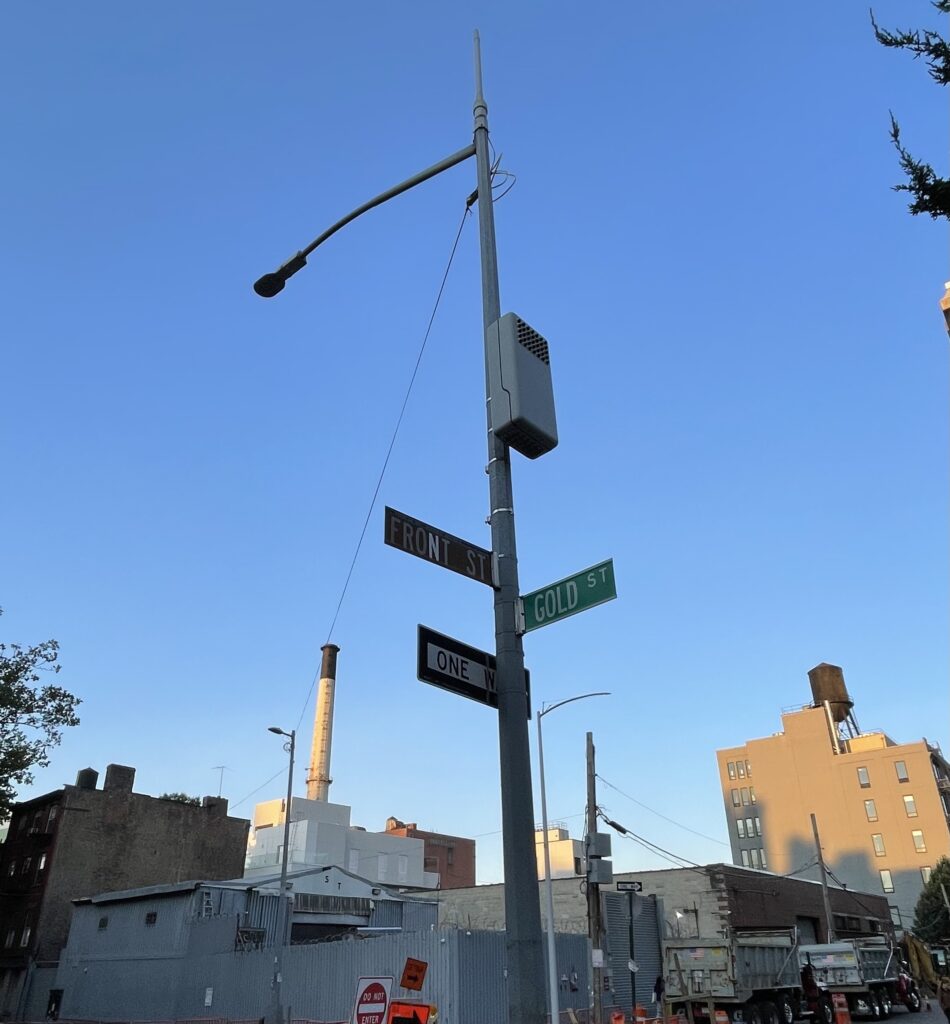
As the once sparse neighborhoods of Brooklyn were suddenly burgeoning with new immigrants in the 1850s – particularly Catholics from Ireland and Germany – the newly-created Diocese of Brooklyn was pressed to meet the demand for more local parishes. The Bishop of Brooklyn, Rt. Rev. John Loughlin, a native of Co. Down, Ireland,1 began commissioning the construction of churches throughout the city.2 In 1860, Loughlin was especially keen to erect a Catholic parish church in Irishtown and he had his mind set on a corner lot at the intersection of Front and Gold Streets. However, the owner of the 100’ x 200’ lot, Lucretia Bradish, “…declined point blank to sell it for a Catholic church…” and punctuated the sentiment by adding that, “…one would never be erected on any property that she could control.”3 Bradish, a widow,4 was listed among “The Wealthy Men and Women of Brooklyn and Williamsburgh” in 1847, with assets worth upwards of $10,0005 (the approximate equivalent of $382,000 in 2023).6 She owned multiple properties in the Fifth Ward,7 though she resided in Flushing, Queens.8
The determined bishop was not dissuaded. He circumvented the problem in a bold act of persistence by colluding with a fellow Irishman who owned a local coal and wood business known as Henry Breslin & Son, located on York Street just a few blocks from the desired site.9 Breslin made an offer to Bradish, she accepted, and the land was purchased on August 1, 1860 by Breslin for $14,500 (the approximate equivalent of $548,000 in 2023).10
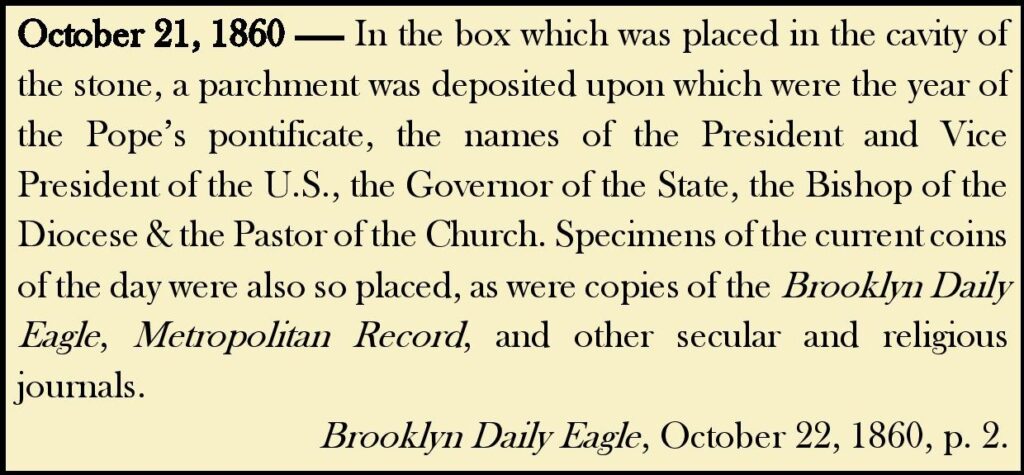
Details of the ruse are unknown, but on Sunday, October 21,1860 at four-thirty in the afternoon, the undoubtedly satisfied bishop preached to a crowd of nearly 7,000 people, and the Navy Yard band provided music “with very fine effect” at the cornerstone laying ceremony for St. Ann’s.11 A month later, on November 19, 1860, Breslin officially turned the property over to Loughlin for “a like consideration.”12
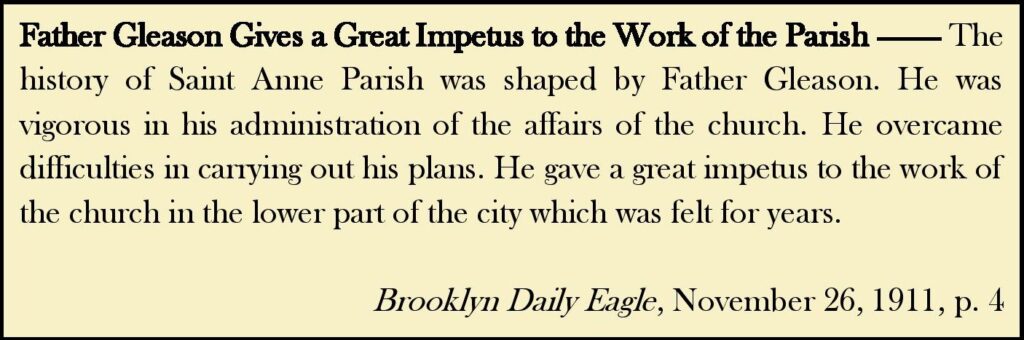
Loughlin then selected a twenty-six-year-old Irish-born priest, Rev. Barthlomew Gleason, as St. Ann’s first pastor.13 Gleason stood 5’10” and had a full face with a high forehead and brown eyes. His nose was straight, and his mouth was medium with a round chin below it. He had a fair complexion and dark brown hair.14 He was described as “a well-known but somewhat eccentric priest,”15 who had ”already distinguished himself”16 serving Brooklyn’s Catholics for several years at Holy Cross,17 St. Malachy’s,18 and St. James.19
To fulfill his vision, Loughlin next enlisted the up-and-coming architect Patrick Charles Keely, a native of Thurles, Co. Tipperary, to design St. Ann’s. Keely had earned his reputation as an ecclesiastical architect after he was commissioned to design the Gothic Revival-style Church of Saints Peter and Paul in Williamsburg.20 That Catholic church was located on Second Street, on the other side of the Navy Yard from the future St. Ann’s site on Front Street in Irishtown.21
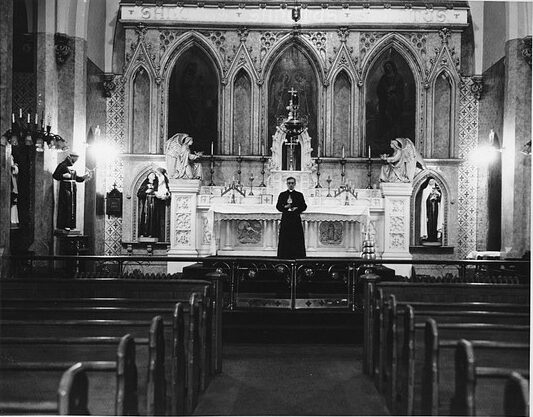
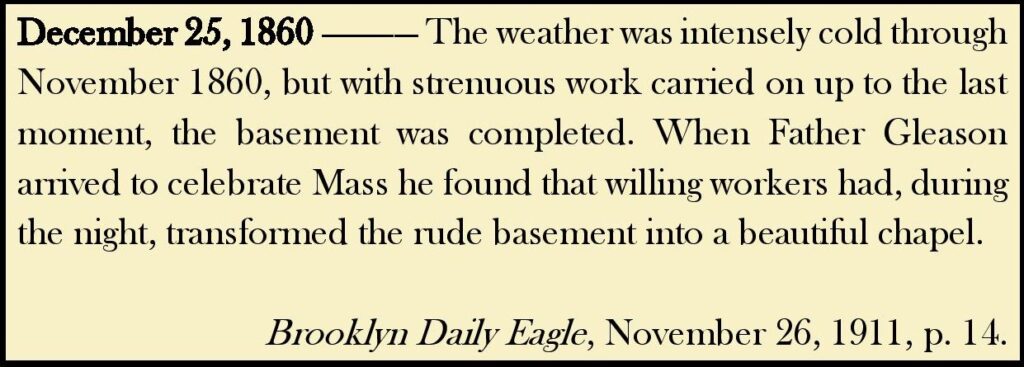
Construction of the new church soon commenced. During this time, Keely lived in Irishtown with his large family and two servants, and another architect named James Farmer lived with them.22 Gleason lived at 193 Front Street,23 very close to the building site. The project progressed quickly, and on Christmas Day 1860, barely a month after Loughlin secured the site for the Diocese, Gleason and his new parishioners gathered in the basement of the unfinished building to celebrate the first mass at St. Ann’s.24
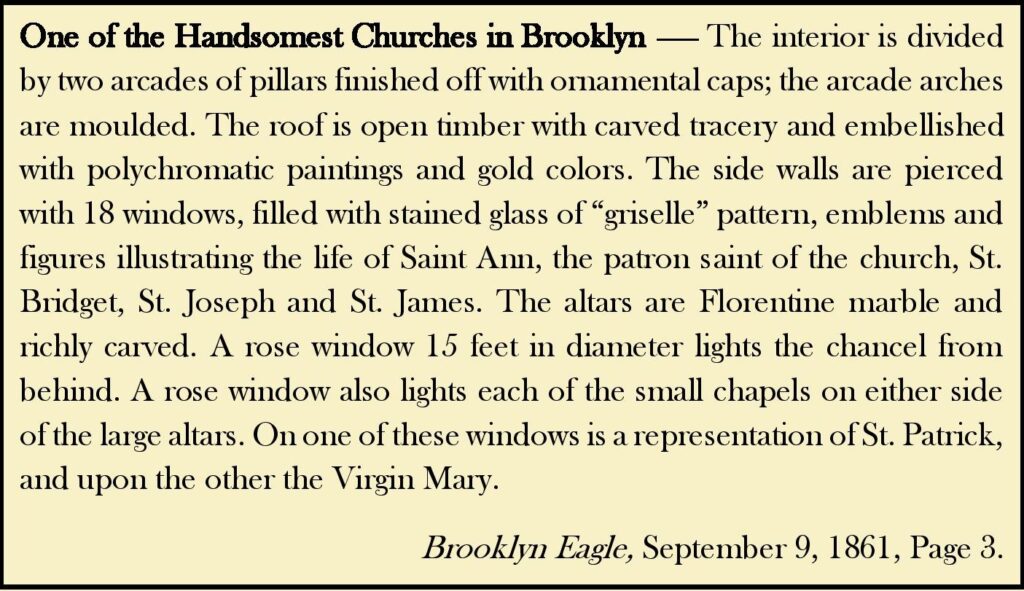
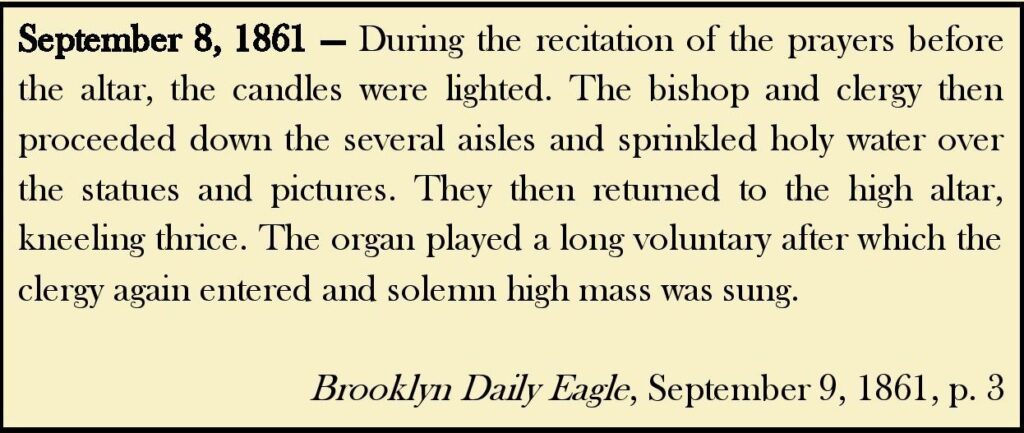
The ambitious work continued, and upon its completion the new church was a 60’ x 126’ structure with a 135’ tower. Final construction costs were estimated at between $22,000 and $25,00025 (the approximate equivalent of $832,000 – $945,000 in 2023).26 It was a grand addition to this working class neighborhood, and on September 8, 1861, the official dedication of St. Ann’s took place on the Feast of Our Lady of the Nativity, with much pomp and circumstance.27
Gleason, who moved into the new rectory at 251 Front Street where he remained for the duration of his service at St. Ann’s,28 had myriad responsibilities. In addition to administrative oversight and routine clerical duties, such as celebrating mass and performing sacraments and rites, Gleason engaged with his parishioners in a variety of ways, in both good times and bad.
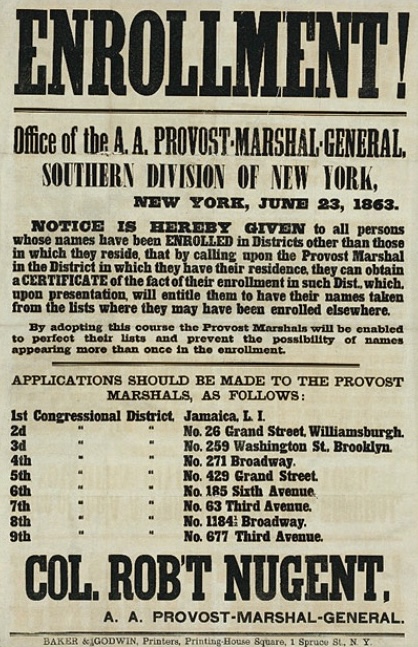

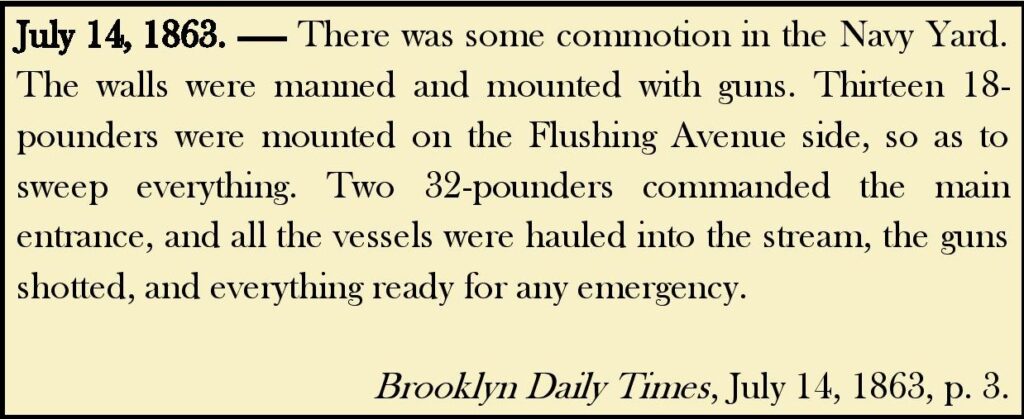
In the summer of 1863, when the mandatory Civil War draft was implemented, Brooklyn’s Fifth and Twelfth Wards bordering the Navy Yard were in tumult.29 Gleason faced unprecedented challenges.
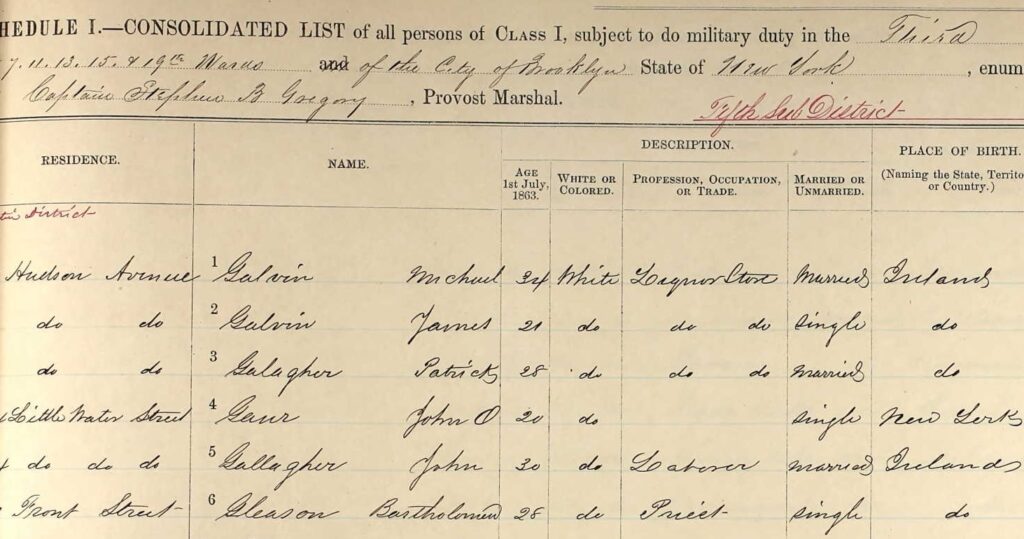
The National Archives in Washington, DC; Washington, DC, USA; Consolidated Lists of Civil War Draft Registration Records (Provost Marshal General’s Bureau; Consolidated Enrollment Lists, 1863-1865); Record Group: 110; Collection Name: Consolidated Enrollment Lists, 1863-1865 (Civil War Union Draft Records); NAI: 4213514; Archive Volume Number: 2 of 5
The priest, who had become a naturalized American Citizen30a year earlier, dutifully registered31 along with 1,959 other residents of the Fifth Ward.32 Ultimately, he was not called into military service, enabling him to carry-out his pastoral duties at St. Ann’s.
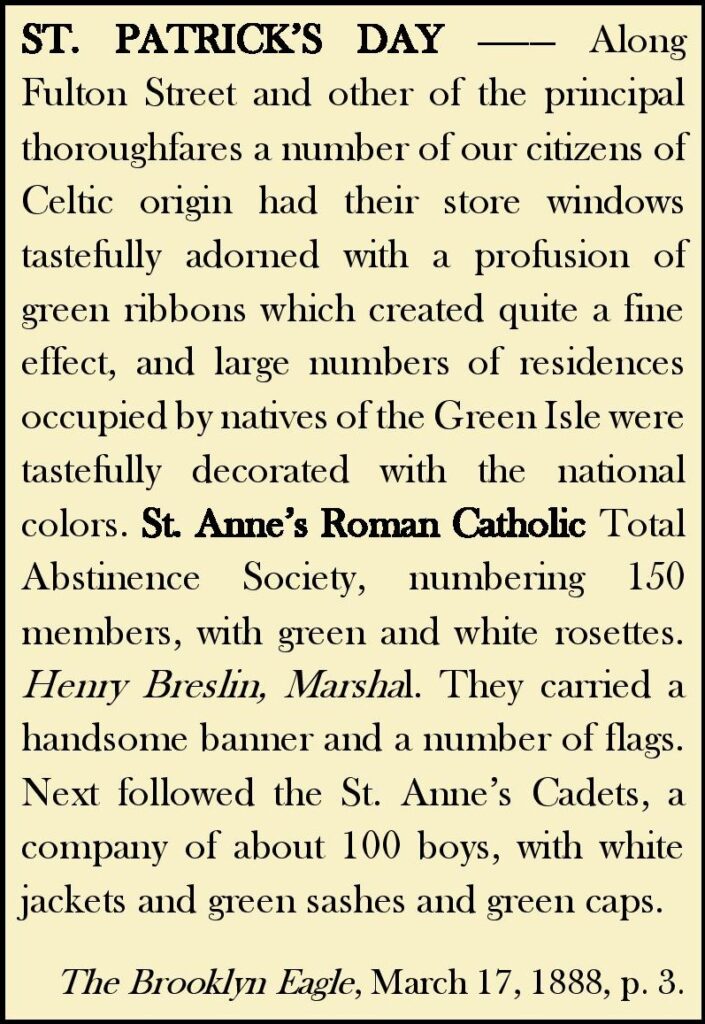
Gleason coordinated lectures,33 attended joyful parish social events like Fourth of July pic-nics,34 and made appearances at festive fairs and celebrations.35 Uniquely, as a pastor in Irishtown, his leadership spoke to the interests of the New York Irish Catholic culture of the time. He promoted temperance,36 hosted an Irish language lecture in the church,37 organized fundraising for the Fenian Brotherhood (which included his own monetary contributions),38and made sure that St. Ann’s was always well-represented in the St. Patrick’s Day parades.39
Likewise, Gleason needed to be at-the-ready in times of crisis, such as the Brooklyn Roman Catholic Orphan Asylum for Boys fire in 1862. The orphanage was funded by donations from the individual Catholic parishes in the Diocese, including St. Ann’s. The night of the fire, 246 boys were displaced, the building was destroyed beyond use, and two children were killed.40Gleason, representing St. Ann’s, was among the pastors designated by the bishop to collect donations for the emergency.41
In April 1865 tragedy struck on a national scale when President Lincoln was assassinated. Again, it was up to Gleason to provide support for the parishioners in Irishtown during a time of collective loss and mourning, and he made sure the doors of St. Ann’s stayed open for anyone who needed its refuge. As the Brooklyn Union reported, ”The Roman Catholic churches were all open from morning till evening…most of the churches of this faith were thronged during the day.”42
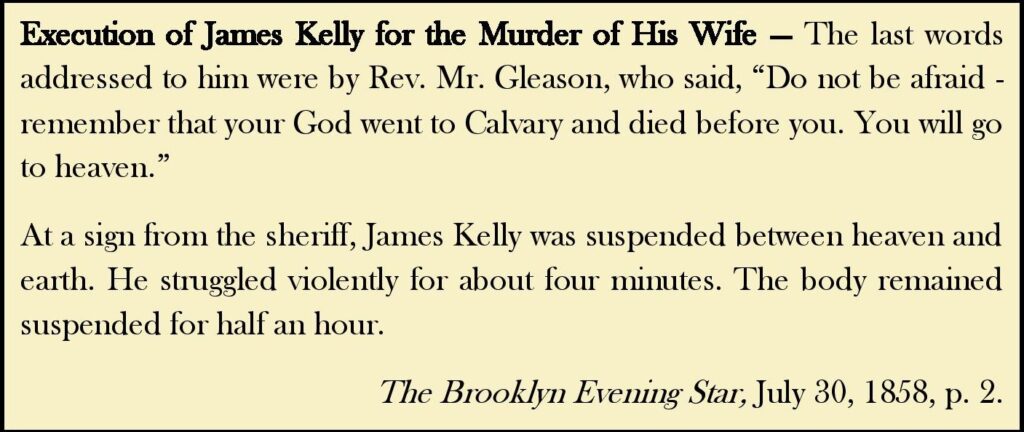
As both a parish priest and a pastor, Gleason was devoted to the parishioners. They in turn confided in and trusted him beyond the confessional. When Gleason was at St. James Church, he had the profound experience of giving daily spiritual care to James Kelly, a man in prison awaiting the death penalty for killing his wife in her sister’s home on Navy Street. The night before Kelly’s execution, a grim event that Gleason dutifully attended, the repentant murderer asked the priest to act as guardian over the affairs he was getting in order that evening, which included making provisions for his children.43
John Mulvey was a resident of Irishtown, parishioner, Total Abstinence Beneficial Society founding member at St. Ann’s,44 and a businessman who had acquired wealth. In January of 1869, six months before he died, he meticulously prepared his will. He bequeathed money to be distributed among various Catholic causes in Brooklyn, including $2,000 for St. Ann’s (the approximate equivalent of $46,100 in 2023),45 and he named Gleason as a co-executor.46
St. Ann’s contribution to the community continued to expand under Gleason’s leadership. In 1869 a school was established in the church’s basement, but demand was high and very soon the space was too small. In 1872, a new school building that could accommodate 1,000 pupils was constructed on Gold Street, adjacent to the church. There, the girls were under the tutelage of the Sisters of St. Joseph and the boys were instructed separately by Franciscan Brothers.47
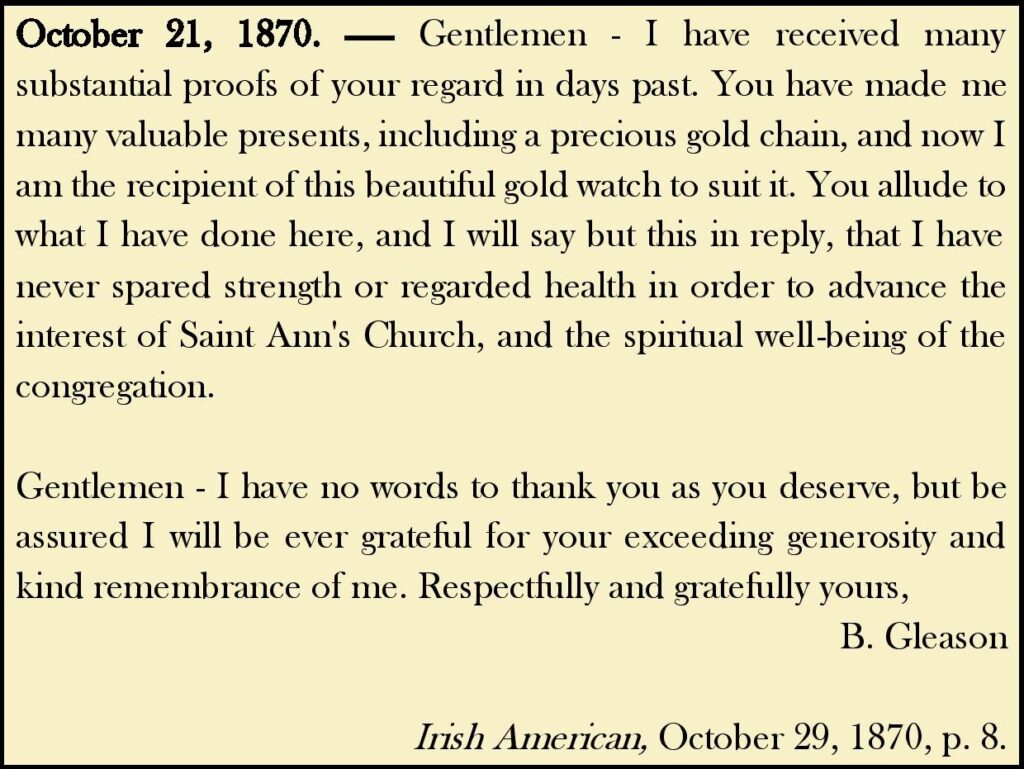
St. Ann’s was grateful for the pastor’s tireless work. In 1870, to recognize his ten years of service, a group of parishioners gathered outside the rectory. When Gleason appeared, they lauded him with a speech and a gold watch that he humbly accepted in a short speech of his own.48
By 1875 things were going well for St. Ann’s and for Gleason, the beloved pastor. Therefore, it came as a surprise to the community when he suddenly handed-in his resignation to Bishop Loughlin.49 Rev. Bartholomew Gleason moved on from his era at St. Ann’s and lived well into his golden years. When he died in June 1920, he was appropriately buried in the St. Ann’s plot in Holy Cross Cemetery, in Flatbush, Brooklyn near the church where his clerical career began.50
Gleason’s successor at St. Ann’s was another Irish-born priest, Rev. James J. McMeel. He served as pastor for thirteen years and initiated renovations on both the church and rectory, but did not live to see the fruits of his labor.51 In September 1888, at only forty-six years old, McMeel passed away in the rectory from diabetic complications.52 His requiem mass, “…one of the largest and most impressive ever held in St. Ann’s,“53 was officiated by Bishop Loughlin and many concelebrants.54 McMeel was remembered for his “kind and genial disposition.”55
The next cleric to lead St. Ann’s was Rev. James Durick, an American-born son of Irish immigrants. Durick grew-up in Brooklyn and was exposed to church life from a young age as his father was sexton of Old St. Paul’s. After attending St. John’s College, Durick studied at Niagara University and joined the priesthood. He had already been serving St. Ann’s for seven years as a parish priest when he was elevated to pastor in 1888. Like his predecessors, Durick was highly regarded. He had a heart for the youth and the poor, and the parishioners “esteemed him for it.“56
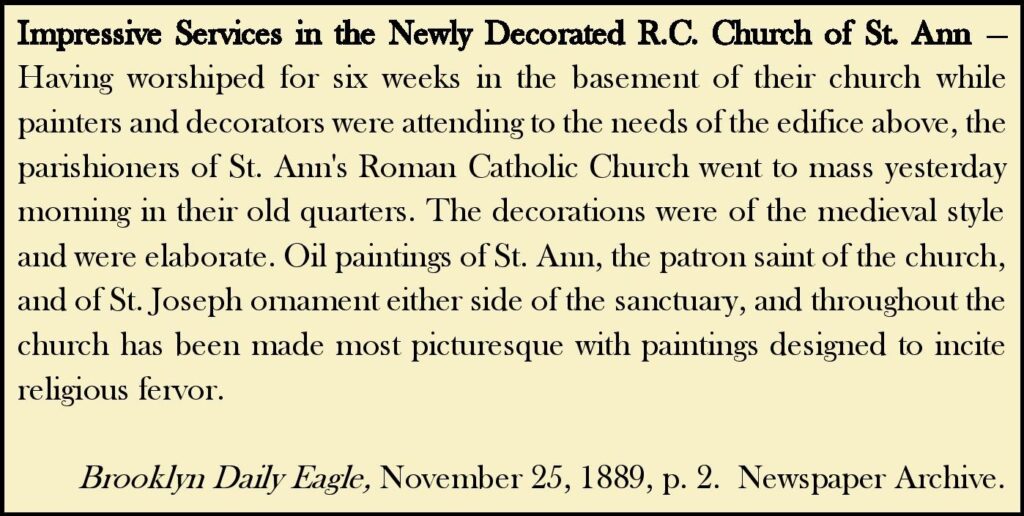
On November 24, 1889, to mark the completion of renovations to the church’s interior, a high Mass was celebrated in the new-and-improved space. Festivities followed in the church basement, then the mirth continued in the adjacent rectory where Durick was reported to have “entertained” visiting priests from various parishes.57
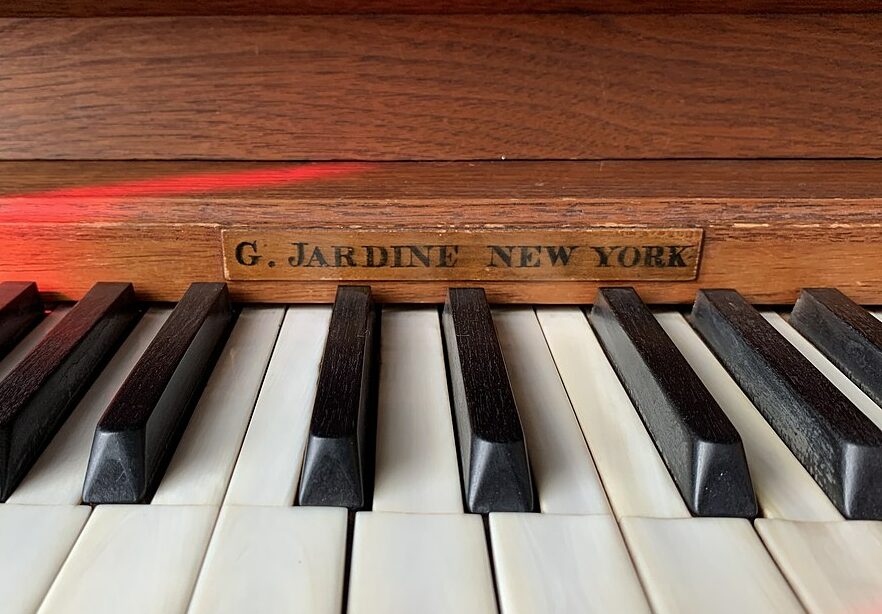

Though Durick was at the helm to unveil the renovations, a project mostly overseen by McMeel, he left his own mark on St. Ann’s as well. In 1891, two years after the renovations, Durick secured a new organ for the church at a cost of $2,200 58 (the approximate equivalent of $76,000 in 2023).59 It was built by George Jardine & Sons who were known for the “high quality of their uncompromising work [which] set them apart from all other organ-builders.60
Durick was also responsible for adding a second school building for the female students,61 and by the time he was transferred in 1902 he had recruited nearly 200 additional adult parishioners.62 To honor Durick, a chime of bells was added to St. Ann’s belfry.63
St. Ann’s continued to be a vibrant church as the century turned and a new generation of parishioners, many still bearing Irish names, filled its pews.64 As the subsequent decades unfolded, the Irish-ness of the neighborhood that surrounded the church faded, but St. Ann’s sallied forth and continued to evolve with the times and needs of the parishioners.
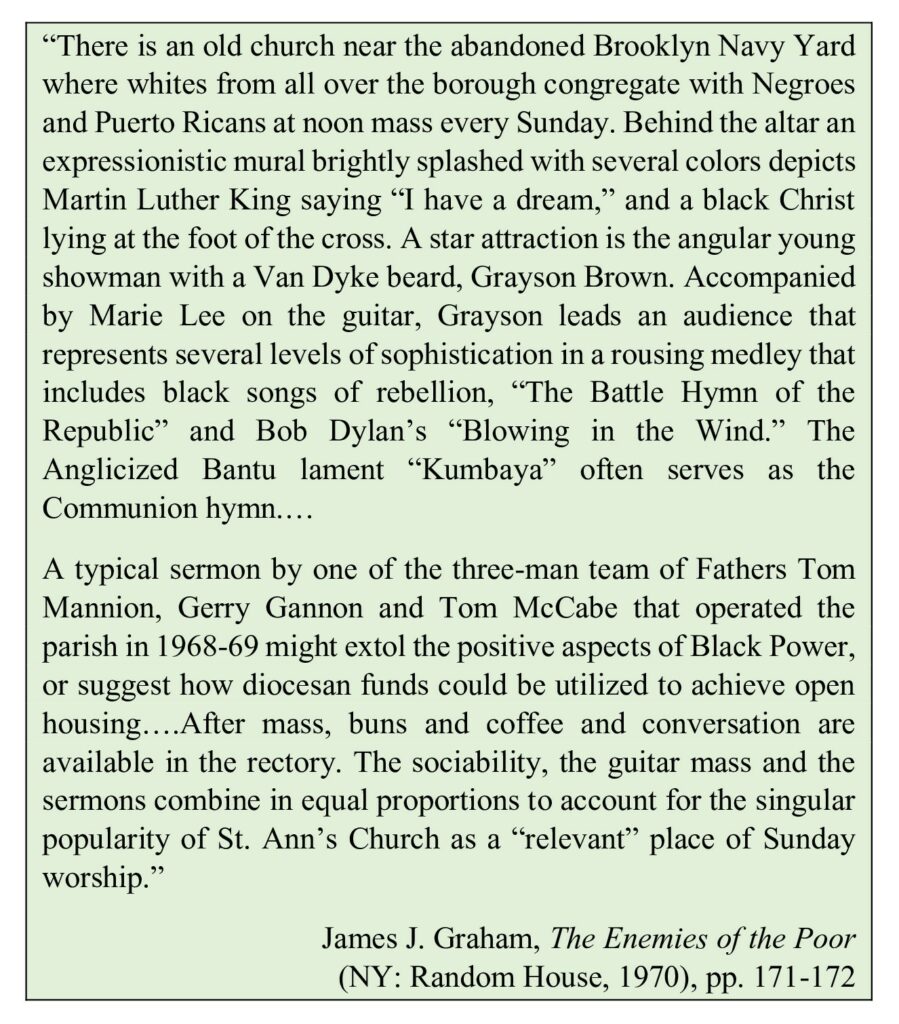
Eventually, the (perhaps inevitable) day came in 1986 when the building known as St. Ann’s Church closed its doors for the last time. The once-sizeable parish was consolidated with St. George’s, a church located on the same block, at 203 York Street, established in 1909 to specifically serve the area’s Lithuanian population. Like St. Ann’s, it too eventually suffered. When the Diocese of Brooklyn merged the two (somewhat ironically, as St. George’s Masses were held in the basement of St. Ann’s Church from 1909 – 1914), St. George’s was used as the physical house of worship and was renamed St. Ann-St. George. This amalgamated parish continued to serve the community until 2003 when those doors also closed.65
In 1992, St. Ann’s Roman Catholic Church was razed. Irishtown’s former stalwart of faith and community was officially gone, and the lot at 251 Front Street sat empty once again.66