by Eric Patrick Cameron, Glucksman Ireland House, New York University
© Eric Patrick Cameron, 2024. All rights reserved.
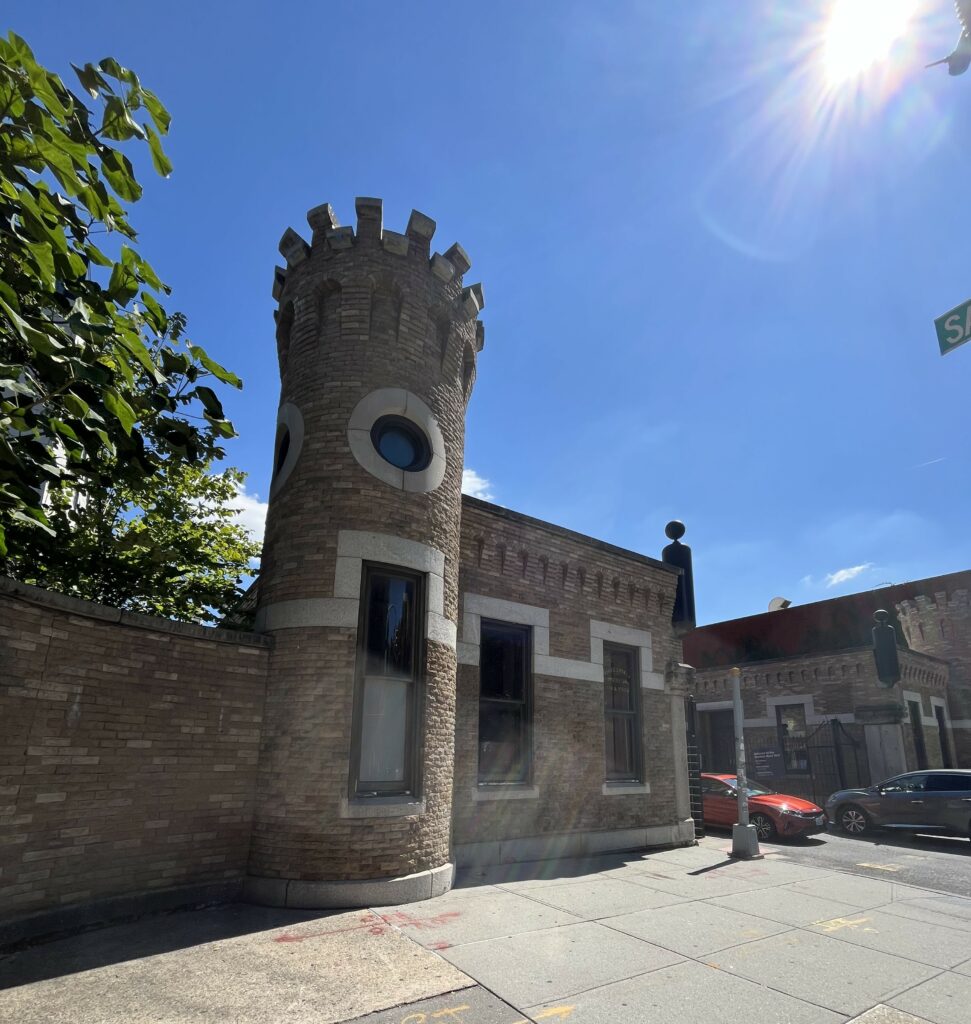
The entrance gate to the Navy Yard, 299 Sands Street, Brooklyn, NY. Kings County Distillery Tasting Room / “The Gatehouses.” September 10, 2024. Photographed by Gracelyn Barmore-Pooley with iPhone 13 mini.
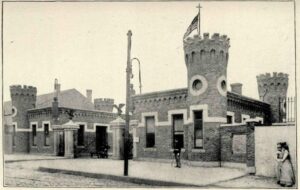
Entrance to the Brooklyn Navy Yard at Sands Street in old Irishtown, 1901.
Credit: Illustrated guide to the Brooklyn Navy Yard prepared by the Brooklyn Daily Eagle Information
Bureau. Brooklyn, New York Eagle Book and Job Printing Department, 1901.
Obtained by the United States Navy on February 23, 1801, the Brooklyn Navy Yard is located upon Wallabout Bay[1] and was an essential industry in New York during the early and mid-nineteenth century.
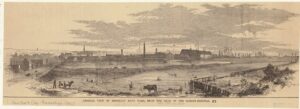
General view of Brooklyn Navy Yard, from the rear of the Marine Hospital.” Stereoscopic Gems. Wallach Division Picture Collection (1850-1930). 1857-02-14. NYPL Dig. ID. 800688
The War of 1812 found the site on the East River particularly useful for fitting out over 100 ships. But it wasn’t until May 30, 1820 when the U.S.S. Ohio, the first ship actually built at the Navy Yard, launched from the premises.[2]
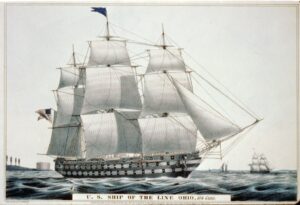
“U.S. ship of the line Ohio: 104 guns.” 1847. Published by N. Currier. Gale Research. Detroit, MI.
The Navy Yard saw even more action in the years shortly prior to and during the Civil War. The escalation of operations naturally was accompanied by an increase in employment for Brooklyn locals, particularly immigrants. Among the ships under construction there in the mid-nineteenth century were the U.S. Steamer Fulton (rebuilt 1850-1851), the U.S. Steamer Frigate Niagara (1854-1856), the U.S. Steamship Iroquois (1858-1859), and the U.S. Screw Steam Sloop Oneida (1861). These were followed, in quick succession, by fifteen ships to meet the demands of the Union during the American Civil War, including the U.S. Paddle-Wheel Steamer Shamrock (1862-1863) which was launched from the Brooklyn Navy Yard on St. Patrick’s Day 1863.[3] Constructed under the supervision of master carpenter Robert Steele, Shamrock was a “double bowed” gun ship.[4]
The Navy Yard employed workers in all types of fields, not just shipbuilding. Many Brooklyn residents worked in security as “watch” and “watchmen.” Z. Cooper, a resident at 156 Hudson Ave, was the watch’s “captain” in 1850.[5] Other jobs included letter carriers, teamsters (horse drivers), cartmen, and clerks, among others.
Workers of the Navy Yard: William L. Stewart
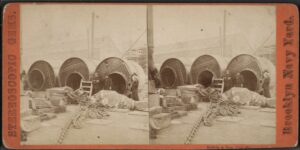
“Boilers & iron-clad shop [ship?].” Stereoscopic Gems (1850-1930). NYPL Dig. ID. G91F172_016F
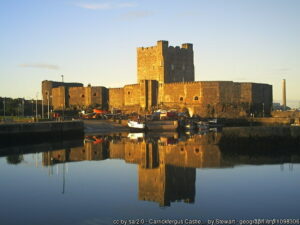
“Carrickfergus Castle, reflections at sunset.” Copyright Stewart and licensed for reuse under this Creative Commons Licence. geograph.org.uk/p/1098306
William likely stayed in New England for some time after immigrating to Boston from Ireland, which is where he and his wife had their first two children together. The Stewart family appears to have lived in various states. His eldest daughters, Margaret and Anna, were born in New Hampshire. His middle child, Catharine or “Kate,” was born in Massachusetts but, just three years later, William F. and Edward J. were born in Michigan. Brooklyn, New York was the family’s next home from 1847.
The Stewarts resided at 166 Sands Street in Ward 5 while William was employed as a laborer at the Navy Yard in the early 1850s. But sometime between 1853 and 1855, his wife, Ann, passed away and he stopped working at the Navy Yard.[8]
By 1860, he was out of work and his now-adult children Kate and William F no longer lived with him. Without a need to be in close proximity to the Navy Yard, he and his three adult children who still lived with him moved from Ward 5 to Ward 10, otherwise known as “Red Hook.” His youngest child, Edward, now 20, was the primary financial supporter of the household, working as a clerk. A thirteen year-old “servant” named Mary Morgan, a New York native but likely the child of Irish immigrants, also lived with the Stewarts.[9]
By 1870, William had moved to Manhattan’s nineteenth ward (NY Ward 19, District 1) where he lived with two of his daughters, Margaret and Anna (“Annie”). Margaret and Anna, now in their thirties, supported themselves and their now-elderly father. Anna tended to the home while Margaret found a career in importing millinery goods. It seems that things were going well for them as Anna reported a personal estate value of $7,000, which is roughly equivalent to $160,000 in 2024.[10]
[1] New York: As It Was And As It Is. John Disturnell. Pg 223. New York. 1876. https://books.google.com.
[2] Images of America, The Brooklyn Navy Yard, in Images of America. Berner, Thomas F. Pgs 9-11. Charleston, SC. Arcadia Publishing. 1999. www.arcadiapublishing.com
[3] Illustrated guide to the Brooklyn Navy Yard prepared by the Brooklyn Daily Eagle Information Bureau. Brooklyn, New York Eagle Book and Job Printing Department1901. Readex: American Pamphlets, Series 1, 1820-1922: From the New-York Historical Society.
[4] Brooklyn Eagle. Tuesday, March 17, 1863. Newspaper. Brooklyn, New York. Newspapers.com.
[5] “Hearnes’ Brooklyn City Directory, for 1850-51.” Hearne, Henry R. and Hearne, William J. Lees and Foulkes Printers, Brooklyn, NY. https://archive.org/details/hearnesbrooklync1850unse
[6] EISB Acct. No. 5518, William L. Stewart, Test Book, Ancestry.com. New York, Emigrant Savings Bank Records, 1850-1883 [database on-line]. Provo, UT, USA: Ancestry.com Operations Inc, 2005.
[7] William L. Stewart, Household 2199, King’s County (Brooklyn City), Ward 5. Ancestry.com. 1850 United States Federal Census, 1850 [database on-line]. Provo, UT, USA: Ancestry.com Operations, Inc., 2013.
[8] William L. Stewart, Household 684, King’s County (Brooklyn City), Ward 5. Ancestry.com. New York, State Census, 1855 [database on-line]. Provo, UT, USA: Ancestry.com Operations, Inc., 2013.
[9] William L. Stewart, Household 561, King’s County (Brooklyn City), Ward 10. Ancestry.com. 1860 United States Federal Census, 1860 [database on-line]. Provo, UT, USA: Ancestry.com Operations, Inc., 2013.
[10] William L. Stewart, Household 75, New York County (Manhattan), Ward 19. Ancestry.com. 1870 United States Federal Census, 1870 [database on-line]. Provo, UT, USA: Ancestry.com Operations, Inc., 2013.