by Maeve Carey-Kozlark, Glucksman Ireland House, New York University
© Maeve Carey-Kozlark 2024. All rights reserved.
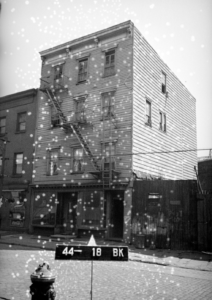
The 6-unit wood-framed house at 81 Hudson Avenue, pictured in 1940 (New York Municipal Archives)
Catherine Holt (neé Whalen) emigrated to the United States in 1850 at the age of fifteen on the Liverpool, a wooden paddle steamer built in 1837 by Humble & Millcrest that made regular trips between Liverpool and New York for the greater part of the mid-19th century. Without a precise date of arrival, it is difficult to determine whether Catherine traveled by herself or with family members; her Emigrant Savings Bank record indicates her father, Patrick Whelan, passed in Ireland while her mother, Catherine Reynolds, resided in Bergen, New Jersey as of 1858.[1] Catherine’s Irish-born husband, Valentine Holt, is listed on the passenger manifest for the July 3, 1849 voyage of the Constellation, also departing from Liverpool.[2] At age 23, this makes Valentine 9 years Catherine’s senior. It is unclear whether the pair were acquainted with one another prior to their arrival in the United States, particularly as Valentine’s 1853 account record lists him as Dublin-born, single, and residing on West 27th St. in Manhattan, whereas Catherine hailed from Athy, Co. Kildare some 70 kilometers away from Valentine’s native Arklow, Co. Wicklow.[3] Sometime between 1853 and 1855, the pair wed and moved to Brooklyn’s Fifth Ward, as the 1855 state census lists the pair as living at 81 Hudson Avenue––a six-unit wood-framed home––with a 6 month old son William, their first of nine children.[4]
The Holts shared a building with overwhelmingly young Irish families with heads of household working in localized trades–Valentine is listed in 1853 as a bricklayer and later in 1855 as a mason, while the rest of their immediate (male) neighbors were predominantly laborers or seamen. While none of these families have Emigrant Savings Bank records based on a preliminary search, there is a decent amount of information on them able to be gleaned from the aforementioned census:
- The Fraim family, consisting of Irish-born father Edward, a clerk aged 24 and New York resident of seven years (at least five of which were spent in the Fifth Ward, per previous census records), Irish-born mother Hannah, aged 23, and children James (4, b. NY county) and Mary (5 months, b. Kings)
- The Daw family, consisting of Irish-born father Michael, a laborer aged 30, Irish-born mother Mary, aged 25, and son Edward (11 mos., b. Kings)
- The Calligan family, consisting of Irish-born seaman George, aged 25, and wife Margaret, aged 21
- The Sheridan family––John and Julia, aged 26, and daughters Mary (2) and Catherine (8 mos.) Sheridan––who are recorded in John’s 1852 Emigrant Savings Bank account notes (#1677) as being Dublin-born and from lower coastal County Wicklow, just as Catherine’s spouse Valentine Holt was. This may indicate a possible prior relation to Valentine, particularly given the close proximity of their points of origin in Ireland, dates of arrival (just one year after Valentine) and ages that place them just two years Valentine’s junior.[5]
- The Whaley family––consisting of a single, non-working, non-widowed Irish mother (Catherine, 52) and her four Irish-born children: Margaret (24), Ann (20, tailoress), Joseph (16, cooper), and William (12).
The McBride family lived next door––likely at 79 Hudson Avenue, as period fire insurance maps label the building at #83 as a Hook & Ladder facility.[6] Irish-born father James, 50, is listed as operating a junk store, while his Scottish-born wife (Mary, 40) likely remained in the home to care for their seven children––Sarah (17), Mary (15), Catherine (13), Isabella (10), James (8), George (4), and Maria (1)––all Scottish-born save for the eldest. They shared the building with just one other family, the Farmers, consisting of Irish-born single father Patrick (42, tailor), daughter Mary (7 mos., b. Kings–possible her mother died in childbirth?), and four Irish-born boarders, all tailors who ranged in age between 10 and 22 and had been in the United States just six months as of the census. Catherine herself worked as a tailoress, for a total of seven residents of 81 Hudson Avenue working in the trade.
While there is no information in the 1952 Historic District Designation Report for 81 Hudson, there is a considerable amount of historical context and data available for 79 Hudson that contributes to a more vivid portrait of daily life for the Holts and their neighbors.[7] A four-story brick Greek revival row home with a storefront on the ground floor, 79 Hudson appears to have been a new building sometime between 1852 and 1855; its first appearance on the Perris map came in 1855. While there is no information available on the architect, it was likely constructed by the lot’s first recorded owner, Gardiner Sherman (1847 to 1854) or by Daniel Hennessey (1854-1860). Sherman was a Manhattan produce merchant, whose store was located in the vicinity of the Catherine Street ferry which docked at the foot of Main Street. While neither the Brooklyn nor the Manhattan city directories from the time list Sherman as ever having occupied 79 Hudson Avenue in a residential or commercial capacity, his successor Hennessey was himself a grocer and is listed as an unspecified occupant of the building occupant in 1856. James A. Butler, also a grocer, purchased the building from Hennessey in 1860 and was listed as its occupant that year, making it likely that the first floor storefront operated in this capacity since at least 1856. Butler later sold the building in 1865 to John Lee, who operated a grocery and general store there from 1856 to 1876 and retained the property until 1878.[8] On a portion of the block that appears to be tight-knit with regard to geographic origin in Ireland, fairly isolated from other residential portions of the neighborhood (bordered by the People’s Coal Yard, Harrison Alley in the rear, and the Hook & Ladder company), family-oriented, and with lots of younger children and recent immigrants taken on as boarders, this storefront likely served as both a material resource as well as a social gathering spot for the Holts and their neighbors.
By the 1860 federal census five years later, Catherine and Valentine Holt had three total children: William, Francis, and Mary, and appear to have moved into a single-family home of their own, although the address is not specified. While still living somewhere in the Fifth Ward, their neighbors were now overwhelmingly American born porters and seamen: New York, New Jersey, Maryland, and North Carolina are all represented. Five years later, the couple has two more children––Valentine Jr., who later passes away in 1880 (source), and James––for a total of five, and is living at the same address with two boarders who share Catherine’s maiden name: Margaret (36) and William (20) Whalen––possibly siblings, given Catherine would have been around 35 herself at this stage).
By 1870, the family left Ward 5 for 739 Myrtle Avenue in Ward 21 (present-day Broadway Triangle area in Brooklyn – source) with two additional children: Stephen, and John, who passed away at some point this same year. By this time, the city’s elevated transit line was in its infancy––at the time, only the 9th Avenue Line in Manhattan was in active operation––and the Lexington and Myrtle Avenue elevated lines were or will soon be groundbroken, eventually providing direct transportation between where the Holts now reside and their former downtown Brooklyn neighborhood near the Navy Yard. Their new building housed 8 or 9 other households representing Ireland, England, Scotland, and Germany and a wide array of professions, with a skew toward more domestic otherwise less hard labor-intensive trades, like tailoring––reflective of their new neighborhood’s location away from industry on the waterfront. Their oldest son William, now around 15 years of age, was listed as an oil peddler. Two years later, The Brooklyn Eagle reported the sale of a 25×100 lot to Valentine Holt on Hopkins near Nostrand Avenue.[9] Five years later, in 1875, Valentine followed his son’s lead and the two were both listed as oil dealers; the couple also had two more children, Katie and Silvester (the latter of whom died in 1880 – source) for a total of six living children. There were now only three families in the building: the Holts, the Watsons (confectioners), and the McLaughlins, all of whom were either Irish or New York-born.
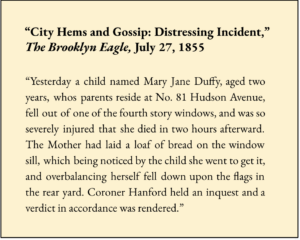
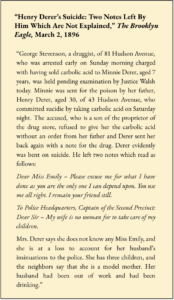
During the Holt’s time in Irishtown and in the years following their departure, 81 Hudson Avenue was host to a number of newsworthy events as depicted in The Brooklyn Eagle, including:
[1] New York, U.S., Emigrant Savings Bank Records, 1850-1883. Retrieved from https://www.ancestrylibrary.com/imageviewer/collections/8760/images/ESB_5-0272?treeid=&personid=&queryId=18646ef8-366c-4e7b-9adc-3f39319bd62d&usePUB=true&_phsrc=Xwj5&_phstart=successSource&pId=234521
[2] New York, U.S., Arriving Passenger and Crew Lists (including Castle Garden and Ellis Island), 1820-1957, Constellation: July 03, 1849, pg. 16. Retrieved from https://www.ancestrylibrary.com/discoveryui-content/view/1023560778:7488?tid=&pid=&queryid=e94df186-fdbc-4a8c-a6b4-01c3bd87869e&_phsrc=Xwj272&_phstart=successSource
[3] New York, Emigrant Savings Bank Records, 1850-1883 [database on-line]; Test Books: 1853, pg. 47. Provo, UT, USA: Ancestry.com Operations Inc., 2005. Retrieved from https://www.ancestrylibrary.com/imageviewer/collections/8760/images/ESB_4-0225?treeid=&personid=&queryId=70604344-6e3f-4cb9-abbb-6ef45789cfca&usePUB=true&_phsrc=Xwj275&_phstart=successSource&pId=218493
[4] New York, U.S., State Census, 1855: Kings, Brooklyn City, Ward 5, Edition 1. Entries for Valentine & Catherine Holt (lines 24-25). Retrieved from https://www.ancestrylibrary.com/imageviewer/collections/7181/images/005207201_00205?treeid=&personid=&queryId=6113111b-82e2-4bc3-afe2-f8dc8bfed157&usePUB=true&_phsrc=Xwj228&_phstart=successSource&pId=1654470443
[5] New York, Emigrant Savings Bank Records, 1850-1883 [database on-line]; Test Books: 1852, pg. 12. Retrieved from https://www.ancestrylibrary.com/imageviewer/collections/8760/images/ESB_4-0083?treeid=&personid=&queryId=7c5a00ac-ac54-47cc-9a90-cb88a489bb5f&usePUB=true&_phsrc=Xwj285&_phstart=successSource&pId=215387
[6]Perris, William. Maps of the City of Brooklyn, 5th Ward, Plate 3 (1855)
[7] Presa, Donald. Vinegar Hill Historic District Designation Report, New York City Landmarks Preservation Commission (1997). Retrieved from https://s-media.nyc.gov/agencies/lpc/lp/1952.pdf
[8] Brooklyn, 1855, surveyed and published by William Perris, civil engineer.; Kings County, Office of the Register, Deeds Liber 359, p.155; Liber 526, p.39; Liber 1324, p.175.; New York City, Department of Buildings, Brooklyn, ALT 4690-1914
[9] “Real Estate Transfers,” The Brooklyn Eagle, October 28, 1873. Retrived from https://bklyn.newspapers.com/image/50391419/?match=1&terms=valentine%20holt