By Gracelyn Barmore-Pooley, Glucksman Ireland House, New York University
© Gracelyn Barmore-Pooley, 2024. All rights reserved.

A map of Rathmelton, engraved in 1836, Ordnance Survey 1st Edition 6-inch Map Sheet Information. County Donegal Sheet 46. Credit: OS200, reproduced with the permission of the National Library of Scotland.
Ramelton, sometimes written as “Rathmelton” or “Ráth Mealtain,” is a market and post-town in the parish Aughnish and the barony of Kilmacrenan in County Donegal.[1] In the early seventeenth century, the town consisted of 45 houses inhabited by 57 British families, and overlooked by a castle built by Sir William Stewart, the original patentee. The town is on the river Lenon, which eventually empties into Lough Swilly. In 1837, when Eneas Cannon was sixteen years of age, there were three main streets in Ramelton, with 341 dwellings for a population of 1,783. The old church stood in ruins by 1858, but the graveyard was intact.
On the shore of Lough Swilly was Fort Stewart, the residence of Sir James Stewart and his wife, Mary Whaley of Whaley Abbey, Co. Wicklow, in the 1830s.[3] Fort Stewart was built around 1730 in a “restrained Georgian style,” with three stories, with seven bays that replaced the original plantation-settler house built in 1619.[4] The building was renovated in the early 1820s, including the addition of a neoclassical porch designed by John Hargrave of Dublin and interior design changes.[5] As one of the prominent landowners in the barony of Kilmacrenan, many locals leased from Sir James and would have been familiar with a Big House like Fort Stewart.
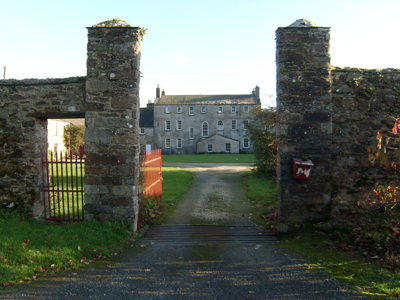
A view of Fort Stewart from the lane, captured in 2016, National Buildings of Ireland Survey, 40904601.
Ramelton was “well situated for military defense” based on its placement by the river’s edge, but was also well-equipped for light industry, with corn-mills, a brewery, and a linen manufactory all in the “vicinity.”[6] Additionally, there was a small salmon fishery, producing about £500 annually mostly for export to England.[7] Pearls of “considerable value” were occasionally found in the river Lenon. The Mall, a “sheltered riverside promenade” set out in the late eighteenth-century, gave the town a unique character and offered a vantage point for viewing both the river’s banks and the town’s markets.[8]
Within the town, there were multiple places of worship. There was a parochial church, and meeting-houses for Presbyterians associated with the Synod of Ulster as well as meeting-houses for Methodists. [9] The parochial church is likely the Church of Ireland’s Tullyaughnish St. Paul, constructed beginning in 1822.[10] There was a small fever hospital, a ladies’ society, and a clothes shop with reduced prices for the poor all associated with these churches. There were also parochial and Presbyterian schools in the town. Alongside the national school-house, there was a parochial school and a Presbyterian school, in one of which Eneas Cannon may have learned to read and write at, enabling him to later work as a bookseller in Brooklyn.
In 1841, the population of Aughnish was 4,974.[11] Eneas Cannon, an account holder at the Emigrant Savings Bank and resident of Irishtown in Brooklyn in 1855, emigrated to the United States in 1844, but he may have left family behind in Ramelton. When he opened his bank account with Emigrant in 1855, he said he had three brothers and a sister. Griffith’s Evaluation in 1858 lists a James Cannon living on Main Street in Ramelton and a Daniel Cannon living on the town’s Mall.[12] The John Cannon from Ramelton who died in Brooklyn in 1862 at age 85 is likely Eneas’s father, who lived with Eneas and the rest of his children in Irishtown in 1855.[13]
While Eneas Cannon is the sole depositor from Co. Donegal in the Irishtown dataset, Tyler Anbinder lists 14 Emigrant Savings Bank depositors from Aughnish, with a per-capita emigration rate of 302 depositors per 100,000 people.[15] Ten of the depositors from Aughnish lived in New York City, with three living in Brooklyn and one address unavailable.[16] Four of the depositors from Aughnish were from Ramelton, and all but one lived in New York City. However, Robert Donahue is listed as living on Hudson Avenue in Brooklyn, where Eneas Cannon lived in 1855.[17] He worked at the flour mills in Ramelton and is recorded as a machinist in his Emigrant account description.[18] Immigrants from Co. Donegal, both Protestant and Catholic, made up a large proportion of Irish in Brooklyn, including men like Eneas Cannon.[19]
[1] Townlands.ie. “Ramelton Townland, Co. Donegal”. Accessed November 24, 2024. https://www.townlands.ie/donegal/kilmacrenan/aughnish/rathmelton/rathmelton/; Samuel Lewis, “Ramelton,” A Topographical Dictionary of Ireland (London, 1837). https://www.libraryireland.com/topog/R/Ramelton-Kilmacrenan-Donegal.php
[2] Askaboutireland.ie. Griffith’s Valuation Record Information, “Church and Grave-Yard,” Donegal, Kilmacrenan, Millford, Aughnish, Rathmelton, Church Street, Sheet No. 45-46, Act 15 & 16, (1858) https://www.askaboutireland.ie/griffith-valuation/
[3] Landed Estates. “Stewart (Fort Stewart)”. Accessed November 24, 2024. https://landedestates.ie/estate/3825
[4] Buildings of Ireland. “Fort Stewart, Killydonell, Donegal.” Accessed November 25, 2024. https://www.buildingsofireland.ie/buildings-search/building/40904601/fort-stewart-killydonnell-co-donegal
[5] Ibid.
[6] Samuel Lewis, “Ramelton,” A Topographical Dictionary of Ireland (London, 1837). https://www.libraryireland.com/topog/R/Ramelton-Kilmacrenan-Donegal.php
[7] Ibid.
[8] Askaboutireland.ie. “Ramelton in the C18 and C19,” Accessed December 3, 2024. https://www.askaboutireland.ie/reading-room/history-heritage/heritage-towns/the-heritage-towns-of-don/ramelton/ramelton-in-the-c18-and-c/
[9] Askaboutireland.ie. Griffith’s Valuation Record Information, “Presbyterian Meeting-House and Yard,” Donegal, Kilmacrenan, Millford, Aughnish, Rathmelton, Back Lane, Sheet No. 45-46, Act 15 & 16, (1858). https://griffiths.askaboutireland.ie/gv4/z/zoomifyDynamicViewer.php?file=072078&path=./pix/072/&rs=40&showpage=1&mysession=2949993324544&width=&height=
[10] Gloine.ie. “Tullyaughnish, Ramelton St Paul,” Accessed November 25, 2024. https://www.gloine.ie/search/building/3329/tullyaughnish
[11] Emigrant Industrial Savings Bank Brooklyn’s Irishtown Depositors, database created at New York University, Fall 2024; http://map.beyondragstoriches.org/
[12] Askaboutireland.ie. Griffith’s Valuation Record Information, “James Cannon” and “Daniel Cannon,” Donegal, Kilmacrenan, Milford, Aughnish, Rathmelton, Sheet No. 45-46, Act 15 & 16, (1858). https://www.askaboutireland.ie/griffith-valuation/index.xml?action=doNameSearch&Submit.x=38&Submit.y=-1&familyname=Cannon&firstname=First+Name&baronyname=KILMACRENAN&countyname=DONEGAL&unionname=&parishname=AUGHNISH
[13] Donegal Genealogy. “Birth, Marriage & Death Notices, Aughnish, Co Donegal, 1829 to 1856.” Accessed November 25, 2024. http://donegalgenealogy.com/aughnishbmdnotices.htm#Deaths; John Cannon, Household 60, Families 261-164, King’s County (Brooklyn City), Ward 5, ED 1, p. 14. Ancestry.com. New York, State Census, 1855 [database on-line]. Provo, UT, USA: Ancestry.com Operations, Inc., 2010.
[15] Emigrant Industrial Savings Bank Brooklyn’s Irishtown Depositors, database created at New York University, Fall 2024; http://map.beyondragstoriches.org/
[16] Tyler Anbinder, Cormac Ó Gráda, and Simone Wegge, “Emigrant Savings Bank Depositor Database, 1850-1858,” version 3.0, September 13, 2019, accessed via https://doi.org/10.7910/DVN/DDG8SW
[17] Ibid.
[18] EISB Acct. No. 9062, Robert Donahue, Test Book, Ancestry.Com. New York, Emigrant Savings Bank Records, 1850-1883 [database on-line], Provo, UT, USA: Ancestry.com Operations Inc., 2005.
[19] John T. Ridge, “The Donegal Colony in Brooklyn.” New York Irish History 33, (2019), 52-53.